Foreign trade enterprise usersBuilding a Websiteoften consider multilingual websites. The vast majority of multilingual websites are created usingtranslation plugins, such as WPML,Polylang, etc. However, this approachis not user-friendly for website operations,build a multilingual website. What is a more scientific method? Let Naiba analyze it for you.
Why Multilingual Plugins Are Not User-Friendly for Operations
Previously, Naibabiji sharedWordPress Multilingual Plugin Polylang Tutorial_Foreign Trade Multilingual Website Buildingan article like this. Indeed,using multilingual plugins like Polylang can instantly turn your website into a multilingual versionand supports integration with machine translation to reduce translation costs.
However, multilingual websites created using such plugins have the following drawbacks:
- Machine translation is not accurate;
- It cannot achieve 100% translation of the entire website content, such as text in images or hard-coded data in webpage code;
- The server is fixed in one location, resulting in suboptimal access speeds for users in other countries;
- Too much translated content can burden the database and affect website speed.
Why these drawbacks exist will be explained in the following analysis of scientific multilingual website building.
Scientific Methods for Building Multilingual Websites
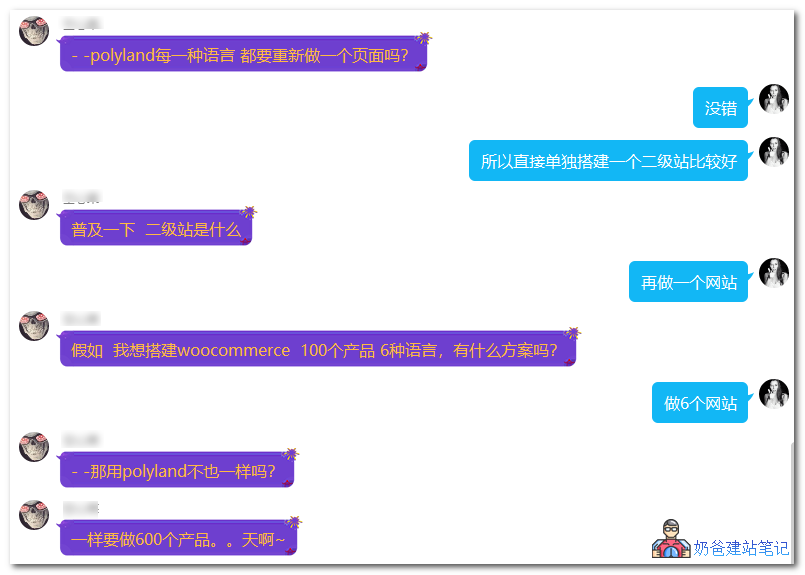
Using the case in the screenshot above, Naiba will analyze for everyone,which method is the scientific way to build multilingual websites。
A more scientific method for building multilingual websites is,to create a separate website for each language, the data and database of each language website are independently separated.。
Let's analyze why this approach is more scientific than using a multilingual plugin for translation.
Advantages of Independently Building Multilingual Websites
Using independent sites to build multilingual websites offers several functions that translation plugins cannot achieve.
1. Each language website operates independently
How to understand this independent operation?
For example, for the China site and the US site, when China's Double 11 comes, you will definitely put Double 11 promotional offers on your homepage slideshow, while the US shopping festival is usually Black Friday. So if you have independent sites, you can launch separate shopping promotions during their respective events.
You say this doesn't matter, wouldn't running promotions on both sides sell more?
Well, then how do you do SEO for your website? Which language do you target? Naiba shares experience; don't hesitate, just build separate sites.
2. Optional website server location
If you are using a multilingual plugin to translate your website, then there is a problem: the server can only be placed in the US or China, so users from one country will always experience slow access to your website.
For independent multilingual sites, you can place the English site on a US server and the Chinese site on a domestic server.
You might say, I can useCDN acceleration, but then you'll encounter a new problem: currently, there is no CDN service provider that is exceptionally fast for both domestic and international access.
3. Workload is similar to plugin translation, with a smaller database
According to the example in the screenshot above, creating a website in 6 languages, with all article data ×6 and 6 independent databases, the performance will definitely be different.
And if it involves products, it also involves search. If the search volume is large, the pressure on the website database is relatively high.
Why is the workload said to be the same as with plugin translation?
The workflow of translation plugins is: for one article, if you want to translate it into several languages, you need to separately create articles in those languages, which is the same workload as publishing corresponding articles on each website. In fact, directly publishing articles in WordPress is even quicker than using translation plugins.

How to Build Independent Multilingual Websites
Still using the example from the QQ chat screenshot above, if you need to build 6 independent websites at once, each requiring over 100 products to be uploaded, it's indeed very annoying.
However, there is a convenient method: backup the website data and then import it into the new website:
- Back up the entire website with uploaded products (Website Backup Tutorial);
- Upload the backup to a new server and restore it;
- Modify the restored database's domain name to match the domain bound to the corresponding language website;
- In the website backend, modify product titles and descriptions to the corresponding language.
This operation eliminates the need to upload products one by one, saving the hassle of uploading product images one by one.
If you want to build a multilingual website in this way, it is recommended to use vultr servers. For reasons, refer to the following article:
If you use vultr, you can also use their snapshot service to quickly create VPS servers with the same data.
In simple terms,like installing a ghost system in the past(You may not have heard of it either), you have a file, and vultr has a copier (snapshot feature). You can directly copy 5 copies of the file and distribute them to different people (data centers).
Isn't it much easier? Once the server is created, the website environment is set up, and the website is built, the uploaded product data and published articles are all there. You just need to modify the website domain address and change the text to the corresponding language.