When it comes to SEO, many beginners find it troublesome and don't know what exactly they should do. In this article, Naiba shares the most basic Google SEO optimization content based on his own experience. Welcome to discuss and exchange ideas together.
Keyword Research
Keyword research is mentioned in any SEO article.
For example, the keywords Naibabiji wants to target areHow to build a website yourself, the main keyword of the website has been changed several times, and currently it is positioned asForeign trade SOHO self-built website, when writing this article, it ranked third.
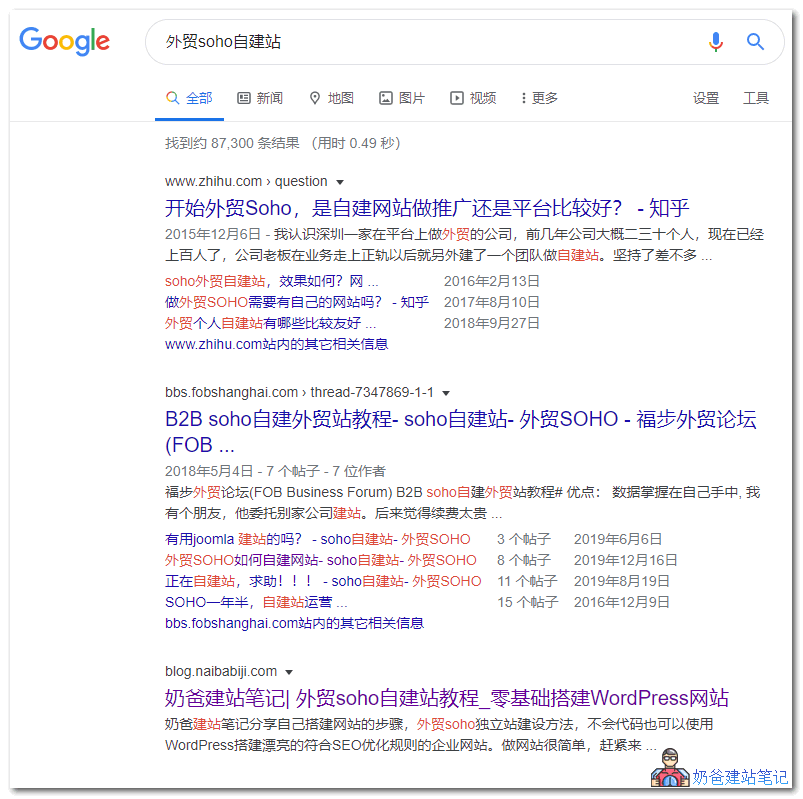
You can see that in Google search results, the first is Zhihu, the second is FOB Business Forum. It would be very difficult for this site to rank first.
But if you search for "foreign trade self-built site", you won't find Naibabiji.
Therefore, "foreign trade soho self-built site" is a long-tail keyword relative to "foreign trade self-built site".
However, whether this keyword selection is correct needs to be verified over time, because currently, the term "foreign trade soho self-built site" may not have much search volume.
For foreign trade enterprises, the keywords on your site are definitely related to your company's products, so research will be relatively simple.
Keyword gap analysis with competitors
This is actually still keyword research. You need to analyze the difficulty of optimizing your chosen keywords. Using the above example, the term "foreign trade self-built site" is much more difficult than "foreign trade soho self-built site", and new sites usually struggle to get good rankings.
After selecting a keyword based on your product, search it on Google to see the ranking results and whether there are large sites already occupying favorable positions.
What are the popular keywords of your main competitors (you can use third-party tools to check), and how difficult is it for you to optimize those keywords.
Page keyword optimization
When writing an article, first think about the purpose of the article and what words you hope it can be found by.
This article doesn't have a fixed keyword. If I had to say, it's Google SEO and SEO. Basic SEO optimization probably isn't searched much.
But why write it?
First, the article is not written for keywords. This article is still meaningful for friends who don't know SEO, as it's a sharing of experience.
Second, although this article may not rank well, its category is underGoogle SEOdirectory, so after writing the article, could it indirectly increase the ranking weight of the page https://blog.naibabiji.com/google-seo?
Naiba himself thinks it should, but it may not be immediate.
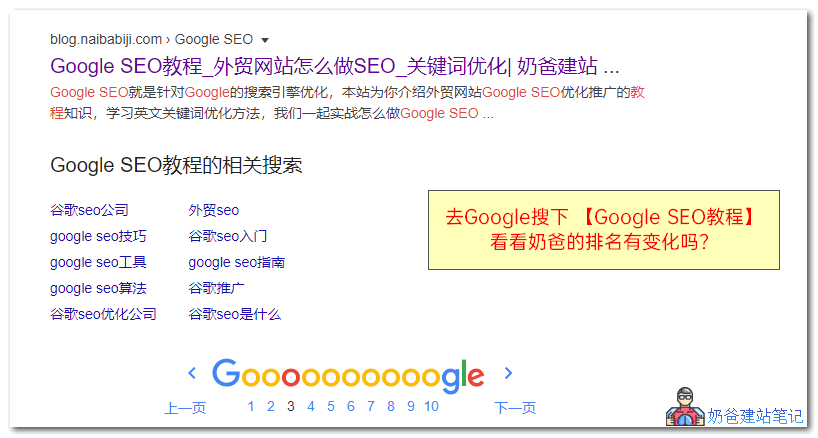
Seeing this, you can search on Google forGoogle SEO Tutorial, to see where Naiba's website ranks. (At the time of publication, it was the last on the third page.)
Title Tags
This is easy to understand: your website title and article title must contain the searched keywords.
For example, you definitely won't find this article through a foreign trade self-built website, but you might find it through Google SEO basics.
Description
If you have installedRank Math, then this description is the one shown in the image below.
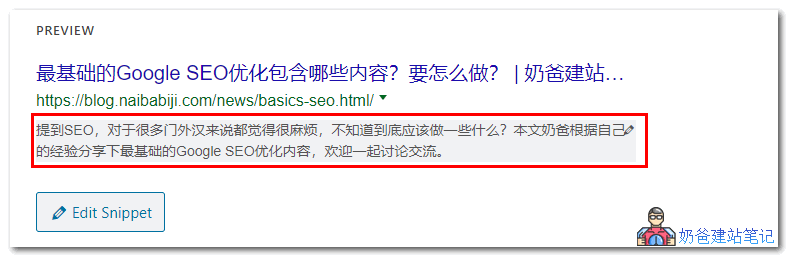
Description is an important part of SEO. Google's advice is that if you don't know how to write it, don't write it, and let Google automatically determine and fetch it.
For SEO optimization of titles and descriptions, refer to the previous article:Writing a correct website title and description
Image optimization
Image optimization has been covered in a previous article, but it mainly discussedalt tags。
Actually, there are other things you can do for image optimization.
For example, image size affects website speed, and website speed is one of the factors affecting SEO ranking.
Balance between image pixels and size: small images are not clear, large images have large file sizes. But if you consider traffic from Google Images, large images have an advantage.
So we need to consider how to handle large images without affecting website speed. At this point, you can consider using CDN or object storage, or other acceleration methods.
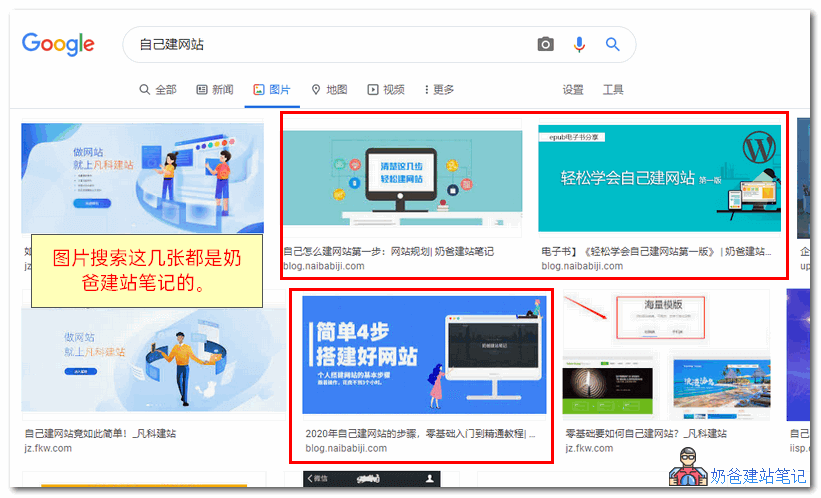
Although the term 'build your own website' is not often searched for images, the images that appear on a corporate website are definitely related to your products, thus containing potential customers. Therefore, image optimization is also a part of SEO.
Internal Links
Internal links simply refer to links between articles, articles and pages, and pages and pages.
This has been written before, so I won't repeat it. See:How should website internal links be done correctly? Are they related articles?
The role of internal links is, on one hand, to facilitate search engine spider crawling, and on the other hand, to enhance user experience. Linking to related articles also helps increase website session time and reduce bounce rate.
Content page optimization
For corporate websites, there are usually the following pages:
- Homepage
- Product/Service Page
- About Page
- Contact Page
What we need to check and optimize here are:
- Whether the code follows the correct semantic structure;
- Whether there is too much junk code;
- Whether there is content that needs to be added.
External links
External links: Naiba has rarely done them in over a decade, so I can't give much experience. But if you do them, the SEO effect is definitely better than not doing them.
Simply put, external links are leaving your website URL on other websites. If you can leave your URL on a well-known industry website, one link can have the effect of several links from small websites. So when building external links, focus on quality, not just quantity.
Too many spam external links can actually harm SEO. If a competitor is harming you with spam links, you can handle it through Google Search Console.