The title and description are the two most important meta tags when we do website SEO optimization. Recently, several friends consulting Naiba about Google SEO had foreign trade website titles and descriptions unsuitable for search engine optimization ranking. Therefore, Naiba will explainHow should website titles and descriptions be written to achieve better search engine rankings?。
Website Title and Description Example Analysis
Just talking about theoretical knowledge may not be easy for everyone to understand, so here we will use practical examples to teach you how to determine which titles and descriptions are suitable for Google SEO ranking optimization.
Let's first analyze the website title
Taking the popularled lightTake this product as an example, other corporate websites or websites selling products can also refer to this.
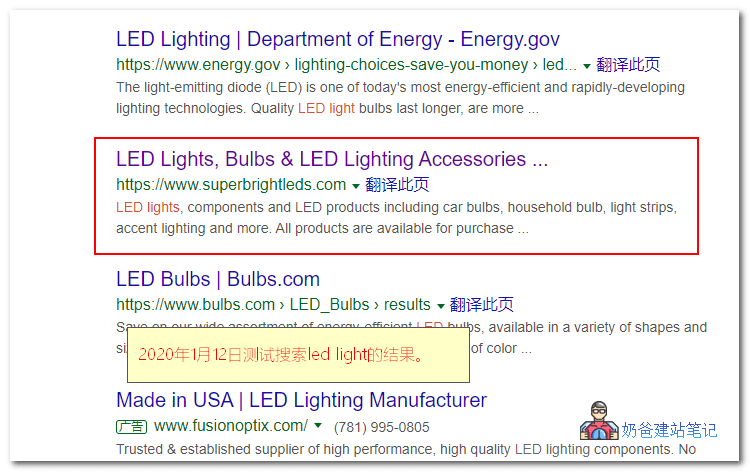
At the time of writing this article, when we search for "led light" on Google, apart from subdirectories of large websites,This superbrightleds site ranks the highest.。
Title: LED Lights, Bulbs & LED Lighting Accessories | Website URL
Then, from the websites ranked beyond dozens of pages on Google, we pick one to look at its title and description。
To avoid negative impact (maybe others don't care about SEO ranking and have other customer sources), we won't show all its content here. Screenshot below:
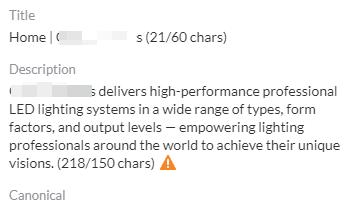
It can be seen that the title of this website is: HOME + website name
Comparison of the titles of two websites:
- LED Lights, Bulbs & LED Lighting Accessories | Website Name
- Homepage | Website Name
The result is obvious.
The first one can be seen when you search for LED lights, LED bulbs, LED lighting accessories, etc.
The second one can only be found on search engines when searching for the homepage or website name.
Do you understand now? Many foreign trade company websites directly use the company name or website name as the page title. Unless you are a well-known company like Google or Apple, it is difficult to get search engine traffic by directly using the company name as the website title.
So, is writing the product name in the title the best choice?
NONONO!
As a foreign trade website, if you are in the B2B business, it is meaningless to only include product keywords in the title. The SEO competition is fierce, and the traffic is not targeted. Your title should aim for the terms shown in the image below.
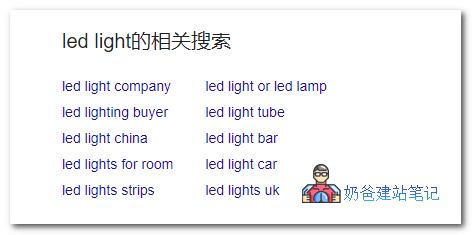
As a 2B merchant, do you think users searching for 'led light company' or even 'led light china' are more targeted than those searching for 'led light'?
1000 searches for the keyword 'led light' may not convert as well as 10 searches for precise keywords like 'led light company' or 'led light china'.
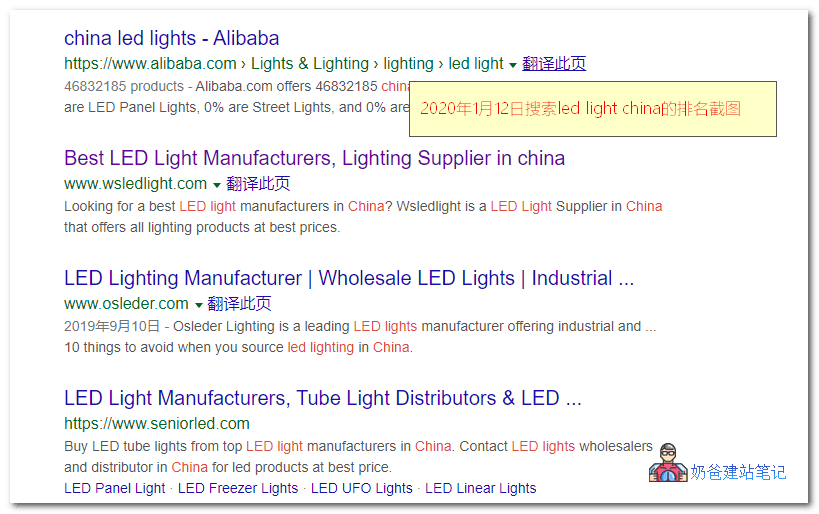
You can analyze the titles of these top-ranking websites yourself.
Next, let's look at the description part.
The descriptions of the independent websites that appeared in the previous search for 'led light' and the above search for 'led light china' are as follows:
- LED lights, components and LED products including car bulbs, household bulb, light strips, accent lighting and more. All products are available for purchase online.
- Looking for a best LED light manufacturers in China? Wsledlight is a LED Light Supplier in China that offers all lighting products at best prices.
- Osleder Lighting is a leading LED lights manufacturer offering industrial and commercial lighting for tri-proof light, panel light, highbay light, floodlight, street light and solar street lights with wholesale price.
- Buy LED tube lights from top LED light manufacturers in China. Contact LED lights wholesalers and distributor in China for led products at best price
Chinese description content, I believe those engaged in foreign trade know what it means, so Naiba will not translate it separately here.
A good description can guide users to click on your website.
Just like when you go to a lighting market, every store sells LED lights. If your store has a sign saying 'Today's special: full discount, free installation, and 10-year warranty', wouldn't more users choose to enter your store?
Google's official recommendations for writing webpage titles and descriptions
The following is theoretical knowledge. Since we are doing Google SEO, we directly quote Google's official recommendations on webpage titles and descriptions.
Create unique and accurate webpage titles
<title> tag tells users and search engines what the topic of a specific webpage is.<title> tag should be placed in the HTML document's<head> element. You should create a unique title for each webpage on your site.
Create appropriate titles and summaries for display in search results
In Google search results, your article's title and description will be displayed. The homepage title can list the website/business name and may include other important information, such as the business's physical location or main operations/products.
Best Practices
Accurately describe the webpage content
Choose a title that reads naturally and effectively conveys the main topic of the webpage content.
Practices to avoid:
- Choose a title unrelated to the webpage content.
- Use default or vague titles, such as „Untitled“ or „New Page 1.“
Create a unique, dedicated title for each webpage
It is best for each page on a website to have a unique, dedicated title, which helps Google understand how that page differs from other pages on your site. If the website has a separate mobile version page, also use an appropriate title for the mobile page.
Practices to avoid:
- Use a single title for all or a large number of pages on the website.
Use short but accurately descriptive titles
Titles should be short and informative. If a title is too long or considered less relevant, Google may only display part of it or an automatically generated title in search results. Google may also display different titles based on the user's query or the device used for the search.
Practices to avoid:
- Use overly long titles that are not practical for users.
- Stuff unnecessary keywords in the title tag.
Use the „description“ meta tag.
A webpage's description meta tag allows Google and other search engines to understand the general content of that webpage. A webpage's title can be a few words or a phrase, while the webpage's description meta tag can be one or two sentences or a short paragraph. Similar to the <title> tag, the description meta tag is also located in the HTML document's <head> element.
Description, also known as meta description, we usually use SEO plugins to write separate descriptions for each article, or automatically extract the first paragraph as the description.
(Naiba's opinion) In normal website operation, it is difficult for anyone to manually write description information for every article. You can also leave it blank by default and let Google automatically generate appropriate description content.
What are the benefits of description meta tags?
The description meta tag is important because Google may use it as the summary of your webpage. Please note, we say „may“ because Google might also choose to use relevant parts of the visible text on the webpage (if that part matches the user„s query well). It is always a very good practice to add a description meta tag for each webpage, in case Google cannot find appropriate text to use in the snippet.
Best Practices
Accurately summarize webpage content
If your description meta tag can be displayed to users as a snippet in search results, write a description that both informs users and sparks their interest. While there is no minimum or maximum word count for the text in a description meta tag, it is recommended to ensure its length is sufficient to be fully displayed in search results (note that users may see snippets of different sizes depending on how and on what device they search), and that it contains all relevant information users need to determine if the webpage is useful and relevant to their search.
Practices to avoid:
- Write description meta tags unrelated to the webpage content.
- Use generic descriptions such as „This is a webpage“ or „A webpage related to baseball cards.“
- Fill the description only with keywords.
- Copy and paste the entire document into the description meta tag.
Use a unique description for each webpage
Using different description meta tags for each webpage is helpful for both users and Google, especially when a user's search might cause multiple webpages from your domain to appear in search results (for example, when searching using the site: operator). If your website has thousands or even millions of webpages, manually constructing description meta tags may not be feasible. In this case, you can automatically generate description meta tags based on the content of each webpage.
Practices to avoid:
- Use a single description meta tag for all or a large number of pages on the website.
References: https://support.google.com/webmasters/answer/7451184?hl=zh-Hans
For more Google SEO tutorials, you can visit Naibabiji Website Building NotesGoogle SEO Category Articlesto view.