
AI has developed very rapidly in 2026, and more and more people are using AI to write articles and do SEO. Webmasters who haven't used AI for SEO may worry:Does AI writing affect SEO?Or will AI-written articles be indexed and ranked?
Naiba's view isthat as long as AI-written articles are not monotonous 100% AI content or meaningless filler, they will most likely be indexed. However, whether they get ranked mainly depends on whether your article meets users' search needs and has its own insights. If it's just AI-generated content with minor human edits, it probably won't rank well (unless the search term has low competition).
Can Google detect AI content?Most likely yes, because AI-written text is still quite different from human-written content, just like plastic surgery faces versus natural faces—most people can tell the difference.
Recently, I saw two related discussions on Reddit. One asked whether ChatGPT could be used to write entire blog posts, and the other asked whether obviously AI-generated content could be published directly.
The comments seemed unanimous: AI is fine, Google mainly cares about content quality.
But upon closer analysis, there are both reasonable judgments and some unsupported claims, such as „AI articles can only rank for a month at most,“ „As long as it passes AI detection, it“s fine,„ and “Adding FAQ and TL;DR makes it easier to rank.„
So I decided to re-analyze this based on Google Search Central's official documentation:
Does AI writing actually affect Google SEO?
More interestingly, the article you are reading right now is itself an experiment.
This article was drafted by AI with assistance in organizing Reddit discussions and retrieving information, then manually reviewed by me to verify Google's official policies, remove unverifiable conclusions, adjust content structure, and supplement my own practical experience.
After publication, I will continue to track its crawling, indexing, impressions, and keyword rankings via Google Search Console.
Conclusion first: Can AI writing be used for SEO?
Yes.
Google does not prohibit websites from using AI-generated content, nor will it automatically lower a page's ranking just because the article was written using ChatGPT, Gemini, or Claude.
Google's core attitude toward AI content can be summarized as:
Google cares more about the quality and purpose of the final content, rather than simply judging based on whether it was generated by humans or AI.
Google Search Central stated in itsAI content guidelinesreleased in 2023 that Google's ranking systems aim to reward high-quality original content that demonstrates what we call E-E-A-T: Expertise, Experience, Authoritativeness, and Trustworthiness. TheyFocus on the quality of the content, not how it is produced.。
However, this does not mean that all AI articles can rank.
If AI is used to generate a large number of pages without added value, primarily to cover keywords and manipulate search results, it may violate Google'sscaled content abusespam policy.
So a more accurate answer is:
AI writing itself does not lead to SEO penalties, but low-quality, homogeneous AI content mass-produced mainly to manipulate rankings poses significant risks.
Why are many people worried that Google will penalize AI articles?
This concern is not entirely unfounded.
AI reduces the cost of article production. In the past, manually writing 100 articles might take months (like some original articles on Naibabiji, which usually take several hours to complete one; even this article, with AI writing the first draft and manual editing up to this point, has taken 38 minutes). Now, with AI, a large amount of content can be generated in days or even hours.
So some websites started using this approach for SEO:
- Batch collect keywords;
- Generate one article per keyword;
- Do not verify facts or incorporate practical experience;
- Auto-publish to the website;
- Hope that some of these articles will rank.
The problem with such content is not just that it is written by AI, but:
- Articles are highly similar (so Naiba does not believe that enterprise sites relying entirely on AI can do SEO well; if that were the case, why would people ask Doubao directly instead of visiting your website?);
- They merely recombine existing search results;
- No original testing, experience, or data;
- Pages look complete but provide no new answers (like Doubao's favorite plausible nonsense);
- The main purpose of publishing is to occupy more search results.
Google„s definition of “scaled content abuse„ is precisely the mass generation of pages primarily to manipulate rankings rather than help users. Google specifically cites the use of generative AI to create pages at scale without adding value for users.
Note that this policy is not exclusive to AI.
Even if articles are entirely written by humans, if they use low-cost outsourcing, stitch together content from other sites, replace synonyms, or mass-produce low-value pages, they can also be considered scaled content abuse.
Therefore, the real criterion is not:
Was this article written by AI?
but:
Was this article produced primarily to manipulate rankings and does it fail to provide sufficient value to users?
What do webmasters on Reddit think about AI writing articles?
Most comments in two Reddit discussions believe that AI content can rank on Google, but they do not recommend directly publishing the first version without sufficient processing.
The most common suggestions include:
- AI is suitable for research and generating drafts;
- Need to incorporate the author's own experience;
- Should add real cases, data, and screenshots;
- Articles should directly answer search questions;
- Need to verify the accuracy of AI-generated content;
- Do not let AI start from blank prompts to complete all thinking for the author.
A representative comment points out that what really causes poor performance of AI articles is often not „being detected,“ but that the article is too similar to other pages. ChatGPT is likely to generate a version similar to currently ranking articles but without higher value, based on existing information on the internet.
Other comments suggest that one should first prepare their own:
- Notes;
- Client questions;
- Actual cases;
- Screenshots;
- Test results;
- Failure experiences;
- Personal opinions.
Then let AI help organize and express, rather than directly asking it to „write a 3000-word SEO article.“
Naiba agrees with this view. For example, articles on theWP Panel websiteare written by Naiba first preparing screenshots, then outlining the general idea, letting AI organize a draft, and then manually revising before publishing.
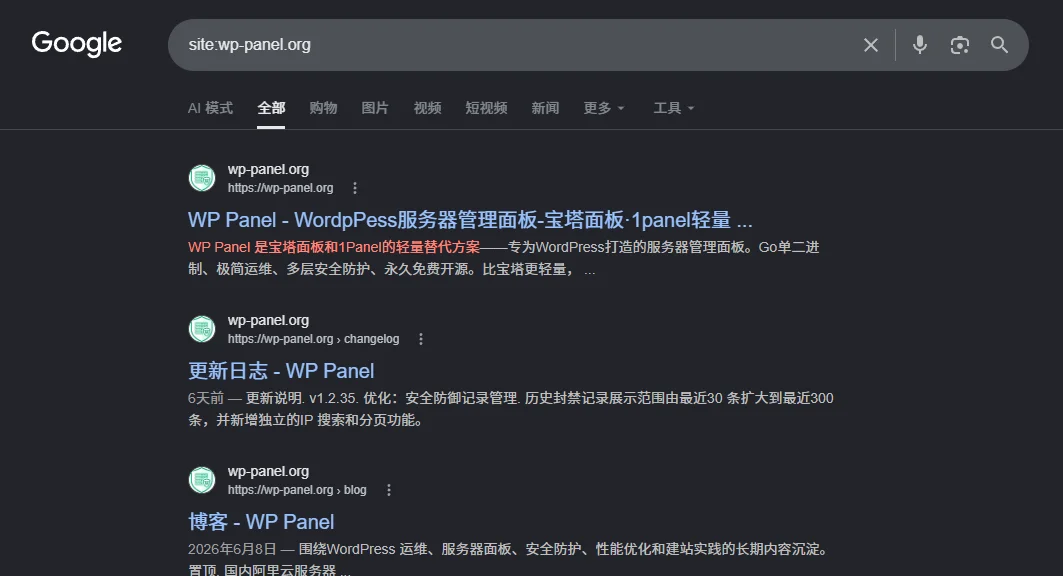
From the indexing perspective, basically all published content has been indexed by Google.
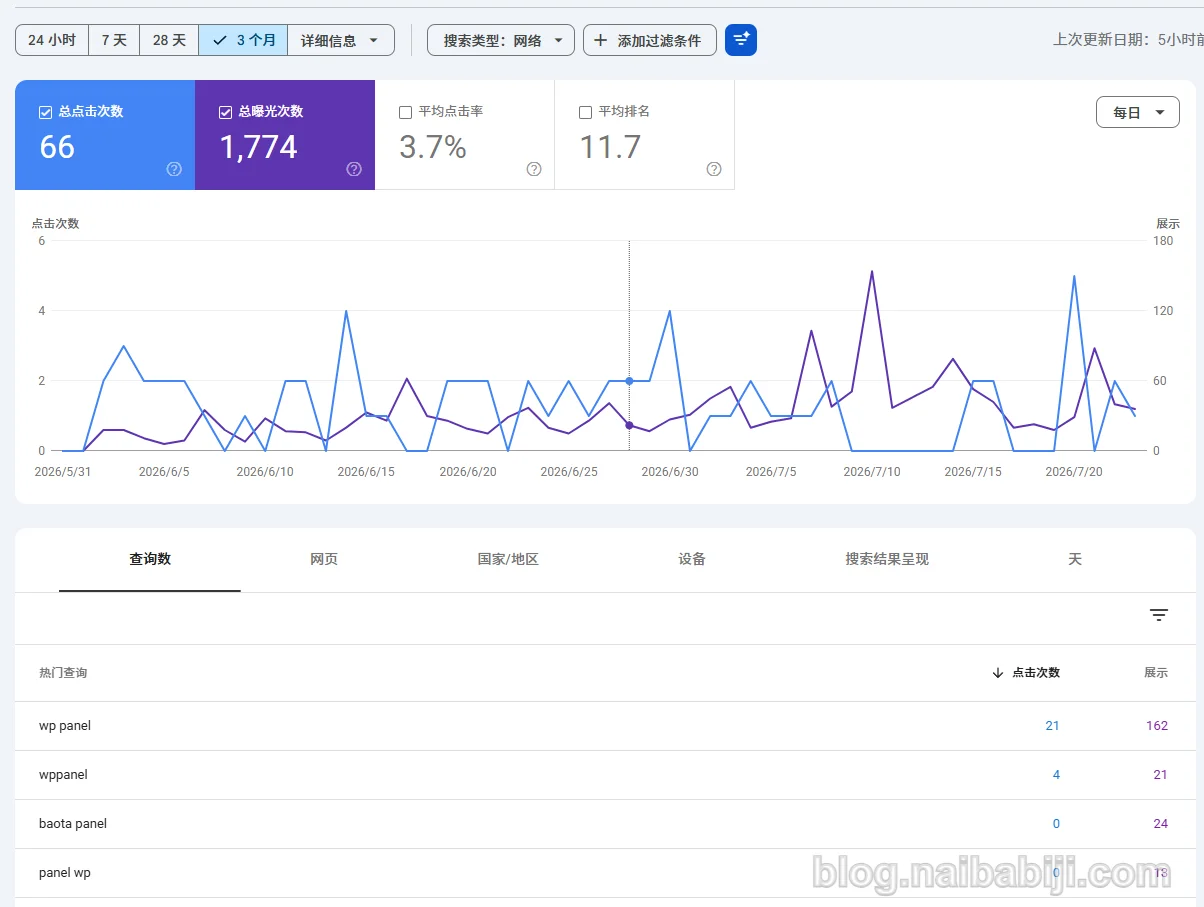
From the SEO ranking perspective, without specific SEO optimization, there are still rankings (not enough energy; plan to do SEO after WP Panel features are fully stable).
So based on Naiba's current experience, using AI to write articles is completely fine for indexing as long as the content is not meaningless.
Also, in the Reddit discussion results, some believe that AI articles may temporarily get rankings, but at most last a month. Others claim that adding FAQ, summaries, charts, or specific structures can increase the chances of AI content ranking or being cited by large models.
These are only personal experiences and cannot be regarded as verified Google ranking rules. Each site is different. The site whose ranking drops after a month might be penalized for generating bulk spam content, or it might be pushed down by competitors' articles.
Adding FAQ, summaries, charts, or specific structures—Naiba does not think it can 100% increase the chances of AI content ranking or being cited by large models. It can only increase the probability under suitable circumstances. What is suitable? When users read it naturally, and the content is not inserted just for the sake of insertion. That is suitable. This can actually be understood as meeting user needs and enhancing user experience, so it might just get good rankings and citations.
How does Google officially view AI-generated content?
1. Using AI itself does not violate Google's policies
Google officially states that reasonable use of AI or automation does not violate Google Search guidelines.
In Google's official Q&A about AI-generated content, Google states that using AI does not give content any special ranking advantage; AI content, like any other content, has the opportunity to perform well in search results if it is useful, helpful, original, and complies with relevant quality principles.
In other words:
- AI content does not get extra points for being „AI“;
- nor is it automatically penalized just for using AI;
- ultimately, it still has to compete with other pages on quality, relevance, and trustworthiness.
2. AI is suitable for assisting research and organizing original content
Google's currentGenerative AI Content Guidelinesmention that generative AI can be used to research topics and add structure to original content.
This is consistent with a relatively safe AI writing workflow:
- Humans decide the topic;
- Humans provide original materials;
- AI organizes the structure;
- AI assists with expression;
- Humans review and take final responsibility.
However, Google also warns that if generative AI is used to create a large number of pages without adding value for users, it may violate the scaled content abuse policy.
Therefore, „AI can assist writing“ and „you can publish AI articles in bulk indefinitely“ are completely different things.
3. Google requires attention to accuracy, quality, and relevance
Google's specific recommendations for automatically generated content are:
- Ensure content accuracy;
- Ensure content quality;
- Ensure content is relevant to user needs;
- Also check titles, descriptions, structured data, and image alt text.
Google also suggests that, where appropriate, you can explain to readers what role automation or AI played in the content production process.
This also shows that websites don't need to desperately hide the fact that they use AI.
Compared to „how to make articles look like they weren“t written by AI,„ the more important question should be:
What did AI accomplish in this article, and what did humans review and supplement?
What kind of content does Google really want?
Google'sCreating Useful, Reliable, People-First Contentguide lists a series of content self-check questions.
Including:
- Does the content provide original information, research, or analysis?
- Does it offer insights beyond common sense?
- When citing other sources, does it add sufficient original value?
- Compared to other pages in search results, does it provide substantial value?
- Does the content demonstrate first-hand experience and sufficient expertise?
- Can users accomplish their own goals after reading?
Google also lists the following as signals that require re-evaluating content strategy:
- Producing content primarily to gain traffic from search engines;
- Producing articles on a large number of different topics, hoping some will rank;
- Using extensive automation to generate content on multiple topics;
- Simply summarizing others' opinions without adding much value;
- Entering areas you are not familiar with, just because you think you can get search traffic.
These questions are especially important for AI content.
Because AI is good at generating articles that are „well-structured, fluent, and seem to say everything,“ but the default content is often just a reorganization of existing public information.
Fluency does not equal value.。
Sufficient article length also does not mean it solves the user's problem.
If AI writes and then humans modify, will it definitely not affect SEO?
Not necessarily.
„Human modification“ itself is not proof of quality; it depends on what was modified.
If the so-called human modification is just:
- Replacing a few synonyms;
- Deleting common AI connecting words;
- Adjusting the order of some sentences;
- Intentionally adding more colloquial expressions;
- Using tools to reduce AI detection rate;
- Changing AI detection results from 100% to 0%;
These operations may change the article's style, but they do not actually improve content value.
Meaningful human modification should include the following aspects.
Verify whether the facts are accurate.
When AI generates articles, it may:
- Fabricate non-existent features;
- Cite non-existent data;
- Confuse products or projects;
- Use outdated policies;
- Write personal opinions as official conclusions;
- Generate sources that look real but cannot be accessed.
Therefore, the product features, versions, dates, policies, and data in the article should be verified.
Google also explicitly requires that automatically generated content focus on accuracy, quality, and relevance.
Add first-hand experience
First-hand experience is the most difficult content for ordinary AI drafts to automatically provide.
For example, in my process of using AI to handle WordPress and SEO content, I encountered these issues:
- AI may confuse WP Panel with another server-panel project;
- When updating old articles, AI may ignore the existing strong keywords on the original page;
- AI easily mistakes old year data as current information;
- AI sometimes supplements unverified data to make the article appear complete;
- If clear context is not provided, AI may directly change the positioning of the original text;
- The same topic given to different models may yield very different conclusions.
This content comes from actual usage, and cannot be reliably generated by having AI summarize public web pages.
Google's advice on people-first content also emphasizes first-hand experience and depth of knowledge.
Delete unverifiable conclusions
AI easily turns a possibility into a definite conclusion.
For example:
- Google can definitely identify all AI content;
- AI articles can only rank for one month;
- 30% manual modification will avoid penalties;
- Adding FAQ can improve rankings;
- Passing an AI detector means the content is safe;
- Articles reaching a certain word count are more likely to rank.
These conclusions cannot be written as definite rules without reliable sources.
They can be expressed as personal observations, or simply deleted.
Add real information increment
Before publishing, ask yourself a simple question:
Compared to the currently ranked pages, what does this article add?
Information increment can be:
- Your own test data;
- Independent research;
- Actual cases;
- Operation screenshots;
- Failure experience;
- Point-by-point verification with official documentation;
- Correction of common misconceptions;
- Continuously updated experimental results;
- Methods summarized from real projects.
Take a simple example. If you and your peers use the same AI tool and the same simple prompt to generate articles, don't you think the articles will be largely similar? Then who should Google rank?
Does AI detection rate affect Google rankings?
Currently, there is no reliable evidence that Google reads third-party AI detection tool scores and then decides page rankings based on that score.
A third-party tool showing an article is „100% AI-generated“ does not mean Google will penalize it.
Similarly, a detection result showing „100% human-written“ does not prove the article is accurate, useful, or worthy of ranking.
Here, we also need to distinguish two issues:
- Whether Google has the ability to identify certain automated content patterns;
- Whether Google directly uses „AI-generated“ as a reason for penalty.
These are not the same thing.
Google states that it has multiple systems, includingSpamBrain, to analyze patterns and signals of spam content, regardless of how the spam content is produced.
Therefore, Google does not need to rely on a simple „AI detection rate“ to judge a page.
It can evaluate from other aspects entirely:
- Whether it is mass-produced;
- Whether the content is highly repetitive;
- Whether the page addresses user needs;
- Whether there is original information;
- Is the information accurate?
- Is the overall website trustworthy?
- Is the content primarily intended to manipulate rankings?
Therefore, there is no need to focus on „fooling AI detectors.“
To be honest, Naiba is skeptical of these AI detection tools. Their ability to identify AI content may not be accurate, and even if it were, I doubt it would be more accurate than Google's identification. After all, how much data does Google process daily? Moreover, Google itself has AI services, so there's no need to fall for using AI detection tools.
Why do many AI articles fail to rank?
AI articles not ranking does not necessarily mean they are penalized.
Common reasons may include:
The keyword itself has no search demand
Even if the article ranks first, if almost no one searches for it, it won't get significant traffic.
Content is highly similar to existing pages
AI-generated articles based on public information can easily become another version of existing search results.
If the current ranking page already solves the problem well, Google has no obvious reason to replace it with a similar new article.
No first-hand experience provided
The article may be well-structured and fluent, but lacks actual cases, screenshots, data, or independent judgment.
Misunderstanding of search intent
For example, when users search „Can AI articles be indexed by Google?“, they mainly want to know whether they can be indexed, why they are not indexed, and how to determine if they are affected by policies.
If most of the article recommends AI writing tools, it does not truly address this search need.
The website lacks topical relevance
A website that has long published WordPress and SEO content discussing AI writing and SEO is more natural.
If a website completely unrelated to SEO suddenly publishes a large number of AI, finance, medical, and software articles in bulk, even if each article looks okay individually, the overall credibility may be insufficient.
Technical issues with the page
Articles not being indexed may also result from:
- robots.txt blocking crawling;
- The page is set to noindex;
- Canonical pointing to another page;
- Insufficient internal links;
- The page is difficult to discover;
- Server or rendering issues;
- A large number of low-value pages consuming crawl resources.
Google also clearly states that meeting basic technical requirements does not guarantee that a page will be crawled, indexed, or displayed in search results, as it is also affected by page accessibility, index settings, and overall website condition. For reference, seeGoogle Search Essentials。
Therefore, it cannot be simply concluded that „AI articles have no rankings“ proves that Google penalizes AI content.
Similarly, an AI article achieving rankings does not prove that any bulk AI content strategy is effective in the long term.
How do I currently use AI to assist in writing SEO articles?
I currently prefer to let AI participate in content production, rather than letting AI independently decide all content.
The general process is as follows:
Step 1: Determine the topic from real needs
Topics can come from:
- Google Search Console queries;
- Questions actually raised by clients;
- Problems encountered during WordPress usage;
- Plugin and theme development experience;
- Search intent not yet covered in old articles;
- Real discussions on Reddit, forums, or communities.
Step 2: Prepare source materials
Provide these contents to AI:
- Original articles;
- GSC data;
- Product materials;
- Actual test results;
- Official documentation;
- Operation steps;
- Known limitations;
- Own opinions and experience.
The more specific the materials, the less likely AI will generate generic articles.
Step 3: Let AI organize and generate a draft
AI can help:
- Summarize discussion points;
- Organize article structure;
- Discover potential omissions;
- Translate technical content into language understandable by beginners;
- Generate alternative titles and descriptions;
- Improve transitions between paragraphs;
- Preliminary organization of long English materials.
Step 4: Manual Review and Supplementation
Key checks before publishing:
- Whether the facts are accurate;
- Whether the citations are authentic;
- Whether the time and version are correct;
- Whether different projects are confused;
- Whether important original content has been deleted;
- Whether it truly answers the search query;
- Whether personal experience and judgment have been added;
- What value it adds compared to existing search results.
Step 5: Update Based on Real Data After Publishing
Publishing an article is not the end.
Subsequently, based on actual query terms appearing in GSC, continue to assess:
- How Google understands this article;
- What users actually searched for;
- Which questions are not covered;
- Whether the title matches the search intent;
- Which sections are worth further supplementing;
- Whether internal links need optimization.
This approach is more reliable than asking AI to „write a complete SEO article“ in one go.
This article itself is an experiment in AI content ranking
The production method of this article is:
- Discovering topics from two Reddit discussions;
- Using AI to organize main posts and comment viewpoints;
- Using AI to retrieve Google official documentation;
- AI generates the first draft of the article;
- Manual review of policies and facts;
- Remove unverifiable or overly absolute statements;
- Incorporate actual experience using AI for WordPress and SEO content;
- Track performance via Google Search Console after publication.
This means this article is not just discussing „Can AI-written articles do SEO?“ but is itself a test subject.
However, the result of a single article cannot prove a universal rule.
Even if this article eventually ranks, it only shows that:
Under the current website, keywords, content quality, and competitive environment, this AI-assisted plus manual review article has a chance to compete in search.
If the article does not rank, it does not directly prove that Google penalized AI content; further analysis is needed:
- Whether the keyword has search volume;
- Whether the website is relevant;
- Whether the content is sufficiently differentiated;
- Whether the page is properly crawled and indexed;
- Whether the title matches search intent;
- Whether competing pages are more valuable.
Experiment Data Log: Continuously Updated
Article Publication Date:July 26, 2026
Article Production Method:AI generates first draft, manual review, supplementation, and modification
Main Keywords to Observe:
- Does AI-written articles affect SEO?
- Does AI-generated content affect SEO?
- Can AI articles be indexed by Google?
- Will AI content be penalized by Google?
- Google AI Content Policy
- ChatGPT writing articles
- AI writing SEO articles
7 days after publication
- Googlebot crawl: Yes
- Indexed by Google: Included within 9 hours of publication (Screenshot verification)
- Whether GSC shows impressions: Not yet, but Bing has given rankings.
- Initial queries: Impressions since July 25, but the volume is too small to be meaningful.
- Average position: None
30 days after publication
- Total impressions: pending update
- Total clicks: pending update
- Average ranking: pending update
- Keywords with impressions: pending update
- Need to adjust title: pending update
- Need to supplement body content: pending update
90 days after publication
- Ranking stable: pending update
- Main traffic keywords: pending update
- Page click-through rate: pending update
- Content modification history: pending update
- Judgment on experiment results: pending update
Summary: The real risk of AI articles is not „being detected“
AI can write articles for SEO, and Google does not prohibit AI-generated content.
What really needs caution is not whether the article has AI traces, but:
- Whether it mass-produces low-value pages;
- Whether it merely summarizes other websites;
- Whether it lacks original information and first-hand experience;
- Whether there are factual errors;
- Whether it is primarily for keyword coverage;
- Whether users still need to search for answers after reading.
AI can help webmasters research materials, organize structure, and generate drafts faster, but it cannot automatically ensure content accuracy, nor can it replace real experience and ultimate responsibility.
So,Instead of agonizing over:
How to make Google not see that the article was written by AI?
First answer:
What does this article add for users that others cannot easily replicate using the same AI tool?
Whether this article can be indexed and ranked by Google will be answered by actual data next.
Google Official Reference
Google Official Reference