Naiba previously shared the „Google Ads Tutorial" and received many inquiries from bosses doing foreign trade or B2B business. Most of them said: I spent a lot on ads, the clicks are okay, but inquiries are few or none. The first reaction of most bosses is to ask Naiba: ——My website is not good, I need to change the design。
Naiba believes the truth is far more complex than this judgment. Website design is only one link in the conversion chain. If the traffic filtering in the front, the logic of intermediate reception, and the trust endorsement behind are not in place, no matter how beautiful the web design is, it is just a "beautiful empty shell".
1. Don't rush to change the design first, see if your ad copy is "precise enough to make people's hearts race"
This is the most easily overlooked but the most fatal link.
Many people's keywords seem relevant, but in factthe intent is vague. For example:
- „Hat“—— The person searching for this word may be a consumer wanting to buy a sun hat, a middleman wanting to wholesale hats, or a student just browsing. The intent is extremely scattered, and you have no idea what they want.
- „Custom hat“(custom hat / hat manufacturer) —— The person searching for this word most likely has a clear procurement need. They want a supplier who can produce according to their requirements and put their brand logo on it.
If your ad targets "hat", 80% of the traffic that clicks in is not your target customer. They click, see it's not a retail store, and leave. You spend money and get "invalid clicks", not "the homepage is not good".
Take Naiba Web Development„s actual example, if I advertise “WordPress Tutorials„ and “WordPress website building„, the conversion effects of the two words are definitely different. Tutorials are mostly for users who want to learn by themselves, while website building is for users with purchase intent.
Precise ad copy essentially helps you filter at the traffic source.Your keywords should be as close to "purchase intent" as possible rather than "general interest intent". B2B business should especially avoid words with strong C-end attributes, such as "cheap", "buy", "for sale" and other words偏向 retail purchase. Consider more words with business cooperation signals like "supplier", "manufacturer", "wholesale", "custom", "OEM".
The judgment standard is simple:If you yourself cannot judge whether the word brings potential customers, then simply don't bid on this word.

2. The page that承接 traffic determines whether the visitor "takes a glance and leaves" or "is willing to leave clues"
This is the second key misunderstanding:Many people point ads directly to the homepage.
What is the homepage? The homepage is the "facade" of your website. It needs to balance brand display, navigation guidance, and presentation of multiple business lines. It is aimed at all visitors, so it is inevitablygeneralized and informationally scattered. A buyer looking for "custom hat" clicks into your homepage and may see a bunch of product categories, company introductions, news updates... They need to find the "custom service" entry themselves and judge whether you do OEM.
But ad traffic is paid for, and visitors have very low patience.They are not obligated to "explore" your website; they just want to quickly confirm: Are you the person I'm looking for? Can you solve my problem? How do I contact you?
At this point,creating a separate landing pageis often a better solution. This page doesn't need to be fancy, but it needs to achieve:
- Strong relevance between headline and ad copy: If the ad is for "custom baseball cap manufacturer," the landing page headline should be "Custom Baseball Cap Manufacturing — Your Design, Our Production," not a generic "Welcome to XXX Company."
- Focused information: The entire page talks about only one thing — we can customize hats for you, here are our advantages, the cooperation process, past cases, and contact information. Do not include irrelevant navigation or distracting information.
- Clear call to action (CTA): Don't just put a small "Contact Us" button. Instead, include forms, direct WhatsApp links, email, and other ways to directly obtain leads, and place them in key positions like above the fold and at the bottom of the page.
The homepage is for people to "browse," while the landing page is for people to "decide."Ad traffic cannot afford browsing; it needs a closed loop for quick decision-making.
3. Even if the visitor has a real need, why should they trust you?
Many bosses think that if ads bring clicks, they should get inquiries. Here's a simple example: if Naibabiji runs ads for foreign trade website building, and you enter Naibabiji's ad landing page through the ad, would you contact me directly on your first visit?
Probably not. You would be willing to contact me only if you had heard of me before or had read my articles and felt I had the capability.
For most foreign trade bosses, especially those who build their own foreign trade websites, in the eyes of customers:Your website might look like a "scam," or at least like a "stranger not worth trusting."
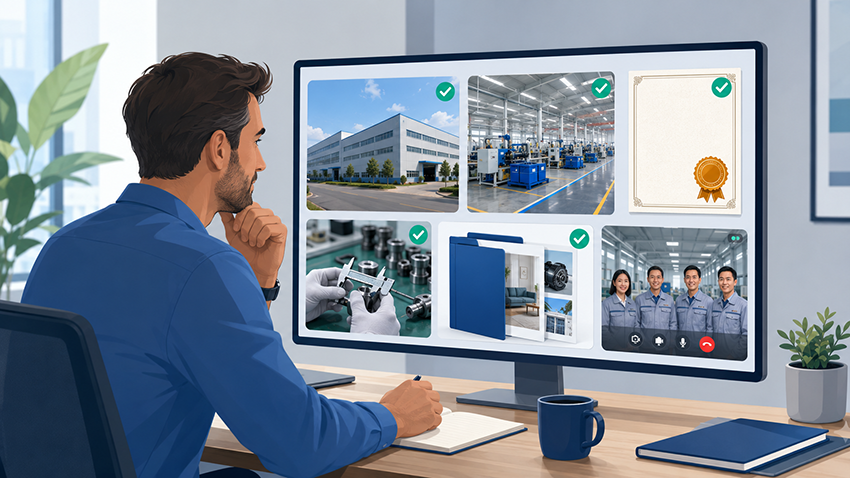
B2B procurement is not buying a cup of coffee; decision-makers often bear the risk of choosing the wrong supplier — delivery delays, substandard quality, or being cheated out of money. Therefore, before sending an inquiry, buyers instinctively evaluate:Is this company reliable?
If your website is new, the domain registered less than a year ago, the company name has no industry reputation, and there are no news or reviews about you on Google, then visitors will hesitate. This is not something the homepage design can solve; it's abouttrust assetsthe problem.
A buyer might subconsciously check these signals:
- Is company information transparent?Is there a real office address, factory photos, team introduction? Or just a vague "Contact Us" form?
- Are there third-party endorsements?For example, customer cases (even small ones), logos of brands you've worked with, industry certifications (ISO, BSCI, etc.), media coverage, exhibition participation records.
- Is the website "alive"?The latest blog update was three years ago? The product page only has a few stock photos? These will make people doubt whether the company is still operating.
- Are there any real traces of interaction?For example, customer reviews, real questions in the FAQ, and updates on social media.
For a new website doing B2B, the hardest part is not making people know you, but making them trust you.No matter how modern the homepage design is, if these trust elements are missing, visitors will only browse politely and then close the page, never sending an inquiry.
Naiba recently built an official website for a toy manufacturer with over 20 years of industry experience. The website building materials were just a PPT and a few pictures from years ago (I was quite helpless too!)

If it weren't for their reputation in the industry, would you dare to contact them directly after seeing the website information?
4. Good blog posts can build trust, but don't expect them to directly bring inquiries.
This is a causal relationship that many content operators easily confuse.
Continuously publishing professional and in-depth blog articles can indeed indirectly enhance the website's credibility. When a buyer finds that your website not only has products but also professional content like "How to choose hat materials," "Comparison of printing techniques for custom hats," and "Quality control standards in the hat industry," they will think:This company knows the industry, not just a middleman.
Thissense of professionalismwill settle into trust, subtly pushing them when they hesitate to send an inquiry.
However, The impact of blogs on conversion rates is indirect, long-term, and difficult to quantify.It won't suddenly make someone who wasn't planning to purchase send an inquiry, nor will it turn someone who has no need for your product into a customer. Its role is:
- To make those who are already somewhat interested more convinced that you are professional;
- To bring long-tail traffic from organic search, though these visitors themselves have a lower conversion rate;
- To provide evidence that "this company indeed has industry experience" when visitors do background research.
Therefore, you should maintain a blog, but keep the right mindset.Don't expect that after two months of advertising with no inquiries, a few blog posts will "save" you. Blogging is a "slow effort" for trust building, while advertising is a "quick move" for traffic acquisition. Both should work together, but don't confuse their priorities.
Conclusion: No inquiries is a systemic diagnostic issue, not a single attribution problem.
Back to the initial question:If you're running ads with clicks but no inquiries, is it because the web design is not good enough?
The answer is:It could be, but it's likely not the only reason, or even the main one.
Over the years, Naiba has come into contact with many foreign trade websites. When others ask Naiba to build a website, they also provide some industry-leading websites as references. Some leading websites have designs that can be described as outdated, yet they remain leaders. Why? As mentioned earlier in theexample in the article on SEO keyword layoutSimilarly, these websites have a long history and are well-known in the industry. An unattractive website design does not prevent the information it displays from telling you that they are a leading manufacturer in the industry.
Now, look back at the page where you are running ads. Does it contain anything that can make users trust your capabilities?
Is it full of beautifully written AI-generated copy, or are there real customer cases, factory photos/videos? If you were the user, would you trust the content on this page?

To thoroughly determine why there is ad traffic but no inquiries, you need to conduct a systematic investigation:
- Traffic side: Are the keywords precise? Does the search intent match? Does the ad copy filter out non-target audiences?
- Landing side: Does the ad point to the homepage or a dedicated landing page? Does the page have a clear conversion path?
- Trust side: Does the website appear trustworthy to strangers? Is there sufficient third-party endorsement and transparent information?
- Long-term side: Is there ongoing content building to support a professional image?
Only when these four aspects are sound should you discuss whether the homepage color scheme is attractive or whether the buttons are large enough. Otherwise, you are just polishing an insignificant link in a flawed chain.
Confirming and optimizing the above four aspects usually increases the probability of converting ad traffic into inquiries. If there are still no inquiries, further investigation is needed: Is it that no customers are submitting inquiries, or is it due to form malfunctions, emails going to spam, or incorrect statistics from channels like WhatsApp? Is the website failing to clearly communicate the product value, or are your price, MOQ, delivery time, certifications, and service conditions uncompetitive? Additionally, check the actual search terms, regions, devices, and sales follow-up.
Ads not generating inquiries may not be due to a single completely wrong step, but rather a combination of multiple small issues. Only by ensuring data accuracy first, then comparing traffic quality, page performance, and business conditions, can you find the areas that truly need improvement.
Ads can bring clicks, but the story after the click is what determines whether your money is wasted.