
Test period: November 14–15, 2026. This article tests two dedicated servers and one cloud server from anti-ddos.cc Hong Kong HKV1. Prices, stock, routes, and defense policies may change; before purchasing, please refer tothe official package pageand the actual order.
Preface
Recently, Naiba came across Anti-DDoS, a server provider that mainly offers Hong Kong CN2 optimized high-defense, Hong Kong CF unlimited defense (optimized return to China), and Hong Kong CF unlimited defense (international bandwidth) servers. Based on what we've seen so far, this is a provider that has just started to gain attention.
This time, they first provided two dedicated servers for Naiba to test, both ordered as theAntiS05 GOLD 6138model, but with different network routes: one is 100M CN2 GT, and the other is 50M CN2 GIA. Later, they added a Hong Kong cloud server for testing, configured with 8 cores, 8GB RAM, and 50Mbps bandwidth. According to customer service, the CN2 GIA one is paired with a domestic 3C optimized high-defense IP; when attacked, it does not reroute, and scrubbing occurs at the carrier level without increasing latency, with return traffic to China going through CN2 GIA. The other is unlimited defense, with China-bound traffic scrubbed in the US and optimized for return to China.
Since Naiba does not have the conditions for large-scale attacks and stress testing, this test mainly covers hardware, bandwidth, and routes. As for how much attack it can actually withstand, that will only be known after a real attack occurs. If you really need a high-defense server, you can try it on a monthly basis first, and then observe whether the actual defense effect meets your expectations when an attack occurs.
Test Results First
Both servers are in a Hong Kong data center, and network speed is the most直观 result this time: the 100M one had a download speed of about 92–94Mbps, and the 50M one about 47–48Mbps, basically reaching the nominal bandwidth of the package. In the mainland China return route of #216, you can seeCN.HKG.CTGNet、CTCN2.CN.SHA.CTGNet 和 59.43.*and other nodes, consistent with typical CN2 GIA route characteristics; #217 shows mobile network nodes such as AS58807 and AS9808, with twice the bandwidth of #216.
In terms of hardware, both machines are AntiS05 GOLD 6138 packages, but actually provisioned as one single-socket and one dual-socket (because one physical machine was out of stock).
Configuration of the two servers
| Item | Machine #217 · HKSRV3731 | Machine #216 · HKSRV4991 |
|---|---|---|
| Ordered model | AntiS05 GOLD 6138 | AntiS05 GOLD 6138 |
| Merchant specification | 64GB RAM, 960G SSD | 64GB RAM, 960G SSD |
| Measured CPU | 40 vCPU; 1 socket, 20 cores, 40 threads | 80 vCPU; 2 sockets, 40 cores, 80 threads |
| Measured memory | Approximately 62 GiB | Approximately 62 GiB |
| Measured disk | Approximately 892.3G raw disk, root partition approximately 878G | Approximately 892.3G raw disk, root partition approximately 878G |
| Line | 100M CN2 GT | 50M CN2 GIA |
| Provider DDoS protection labeling | Unlimited protection | 200G |
| Primary IP | 156.234.124.xxx | 156.234.80.xxx |
The last segment of the IPs in the article and screenshots has been hidden. The list of dedicated server models on the official website is as follows; you can choose the CPU model that suits your needs.
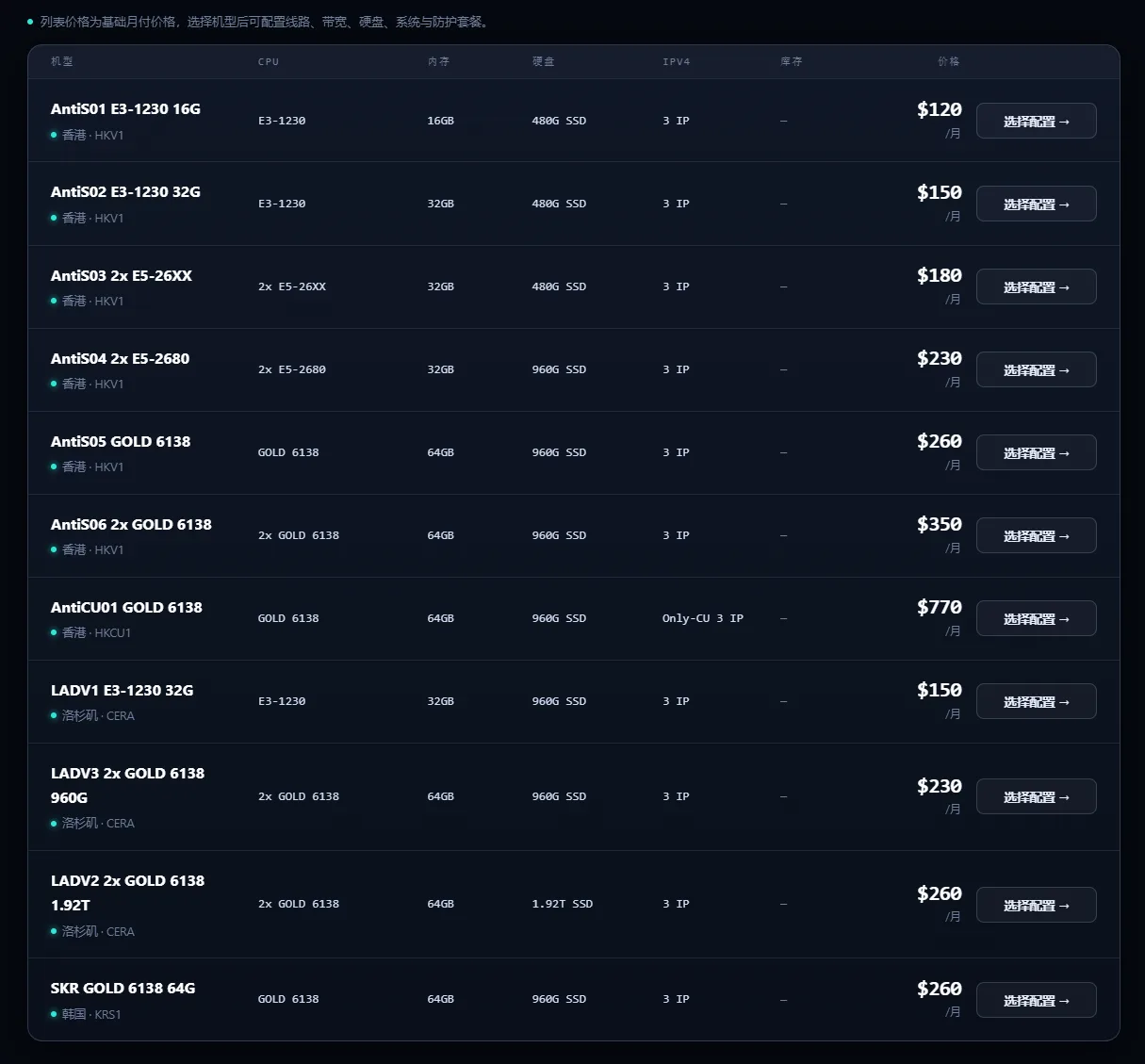
Provider customer service note: if a user happens to encounter out-of-stock inventory while ordering a server, by default the user will be offered a configuration with a hardware upgrade.
CPU, memory, and disk tests
Because both servers use the same CPU model, the single-thread results are almost identical; the dual-socket multi-thread performance is better.
| Test item | #217 | #216 |
|---|---|---|
| Fusion Monster sysbench single-thread | 1215.02 | 1215.11 |
| Fusion Monster sysbench multi-thread | 30025.35, 40 threads | 57489.13, 80 threads |
| CPU stress test | 20.028 seconds, 40 threads | 20.023 seconds, 80 threads |
| Load during testing | 0.00, 0.00, 0.00 | 0.00, 0.00, 0.00 |
The single-core scores are close, indicating that when the two machines run ordinary websites, WordPress, panels, and routine services, the single-thread experience will not differ noticeably due to different network routes; for tasks that can fully utilize multiple cores, such as compilation, batch processing, and video transcoding, the dual-socket #216 will have an advantage.
The memory usage STREAM test results are as follows:
| STREAM project | #217 | #216 |
|---|---|---|
| Copy | 18141.0 MB/s | 11266.1 MB/s |
| Scale | 10901.4 MB/s | 13132.9 MB/s |
| Add | 12423.6 MB/s | 14463.9 MB/s |
| Triad | 12483.0 MB/s | 14515.5 MB/s |
Disk usage: fio test on the root partition, 4K and 1M results are as follows:
| Test item | #217 | #216 |
|---|---|---|
| 4K read | 98.35 MB/s, about 24.6K IOPS | 157.94 MB/s, about 39.5K IOPS |
| 4K write | 98.61 MB/s, about 24.7K IOPS | 158.35 MB/s, about 39.6K IOPS |
| 1M read | 124.29 MB/s, about 121 IOPS | 216.62 MB/s, about 211 IOPS |
| 1M write | 132.57 MB/s, about 129 IOPS | 231.05 MB/s, about 225 IOPS |
In addition, sequential write of temporary files: #217 about 2.6GB/s, #216 about 1.9GB/s. Both servers have just been provisioned and have not yet deployed any websites or actual workloads, so the disks are in an idle state and the measured results will look better. After installing panels, websites, logs, and backups later, actual disk performance will change with usage, which is also the normal difference between a new machine and one that has been running for a long time.
Another Hong Kong cloud server
This cloud server is not from the same product line as the two dedicated servers above; its starting price is cheaper and it also includes security protection. The configuration provided by the vendor is 8-core CPU, 8GB memory, 100GB system disk, and 50Mbps bandwidth. After actually booting it up, what is seen is KVM virtualization, Intel Xeon E5-2680 v4, 8 vCPUs corresponding to 8 physical cores, and the system is Debian 13.
| Test item | Cloud server actual test results |
|---|---|
| CPU | E5-2680 v4, 8 vCPU, single-socket 8 cores 8 threads |
| Memory | 7.76 GiB, about 7.4 GiB available; no Swap |
| Disk | 100GB virtual disk, root partition about 98.2G |
| sysbench single-thread | 834.63 |
| sysbench multi-thread | 6169.78, 8 threads |
| STREAM Copy / Scale | 13552.4 / 7798.0 MB/s |
| fio 4K read / write | about 45.8K / 45.9K IOPS |
The CPU model of this cloud machine is not on the same level as the Gold 6138 on a dedicated server, but it is sufficient for small websites, proxy forwarding, development environments, or lightweight services. It cannot be directly compared with 40-core or 80-core dedicated servers in terms of multi-thread performance. The disk is a virtualized device, and its 4K random read/write performance is fairly good, which is basically sufficient for running websites on a daily basis.
Network speed test
The three servers tested this time all have different bandwidth sizes,First, look at the most intuitive download results.
| Test item | #217 · 100M CN2 GT | #216 · 50M CN2 GIA | Cloud Server · 50M |
|---|---|---|---|
| Cloudflare 10MB | 93.3Mbps | 48.5Mbps | about 45Mbps |
| Cloudflare 50MB | 92.5Mbps | 47.7Mbps | about 45Mbps |
| Speedtest.net download | 94.36Mbps | 47.23Mbps | 43.33Mbps |
| Hong Kong node download | 94.47Mbps | 46.62Mbps | 47.32Mbps |
| Tokyo, Japan download | 76.69Mbps | 46.62Mbps | 47.42Mbps |
For Hong Kong and Japan directions, all three machines can achieve speeds close to the nominal bandwidth. #217 has the largest port and also the highest international download; #216's 50M CN2 GIA is basically fully utilized; the cloud server can also reach around 47Mbps in Hong Kong and Tokyo directions.
However, when accessing these 3 Hong Kong servers from mainland China, the speed is affected by different cities and different ISPs. Naiba believes that script test results have little reference value. The actual performance still needs to be tested from your own computer to determine how fast the network access to the server is in your region and with your ISP.
Naiba's home broadband is 300M. Below are the results of downloading a 512MB temporary file from this machine to each server individually:Each of the three servers was tested 3 times, with no simultaneous downloads from other machines during each test (though a phone was streaming short videos).
| Server | 1st time | 2nd time | 3rd time | Average speed |
|---|---|---|---|---|
| #217 · 100M CN2 GT | 48.04Mbps | 50.95Mbps | 45.73Mbps | 48.24Mbps |
| #216 · 50M CN2 GIA | 40.63Mbps | 41.43Mbps | 39.41Mbps | 40.49Mbps |
| Hong Kong cloud server · 50M | 46.62Mbps | 46.52Mbps | 46.64Mbps | 46.59Mbps |
| #217 · 100M CN2 GT (4 concurrent connections) | — | — | — | 88.39Mbps total |
From actual downloads on this machine, from Naiba's side (Chongqing Telecom) line, these 3 machines can basically download at full speed, and the bandwidth is not falsely advertised. However, as mentioned earlier, the line quality from mainland China to Hong Kong data centers is greatly affected by the region and ISP. It is best to purchase a monthly machine for actual testing.
Three-network return route
| Return direction | #217 · 100M CN2 GT | #216 · 50M CN2 GIA | Cloud Server · 50M |
|---|---|---|---|
| Telecom | CTGNet and CN2-BackBone appear; Guangzhou segment is about 64–67ms | CTGNet and CN2-BackBone appear; Guangzhou segment is about 6–10ms | CTGNet appears |
| China Unicom | AS9929 and CNC-Backbone appear; subsequent hops to Guangzhou are about 9–50ms | AS9929 appears, and AS4837 also appears; some intermediate hops exceed 150ms | CUG and 9929 appear |
| China Mobile | AS58807 CMIN2-NET and AS9808 CMNET appear; about 5–18ms | AS58807 CMIN2-NET and AS9808 CMNET appear; about 1–13ms | CMIN2 appears |
In the return-path test, #216 shows CTGNet and CN2-BackBone on the China Telecom route, consistent with the CN2 GIA line description; #217 shows CMIN2-NET and CMNET on the China Mobile route, and the cloud server's three-network routes can also identify optimized line nodes.
On the outbound path, when ipip.net accesses the two dedicated servers from a China Telecom node in Chongqing, #216 showsCN.HKG.CTGNet, while #217 passes throughCTCN2.JP.TYO.CTGNet, South Korea, and US-direction nodes before reaching Hong Kong; traffic first goes abroad for scrubbing and then returns to China, serving a defense purpose. The outbound and return paths are two different directions, and line names can only serve as a reference; to understand the differences between CN2, CN2 GIA, and CN2 GT, you can check this site'sline description, then use theVPS test scriptto re-test your own machine.
itdog nationwide Ping test
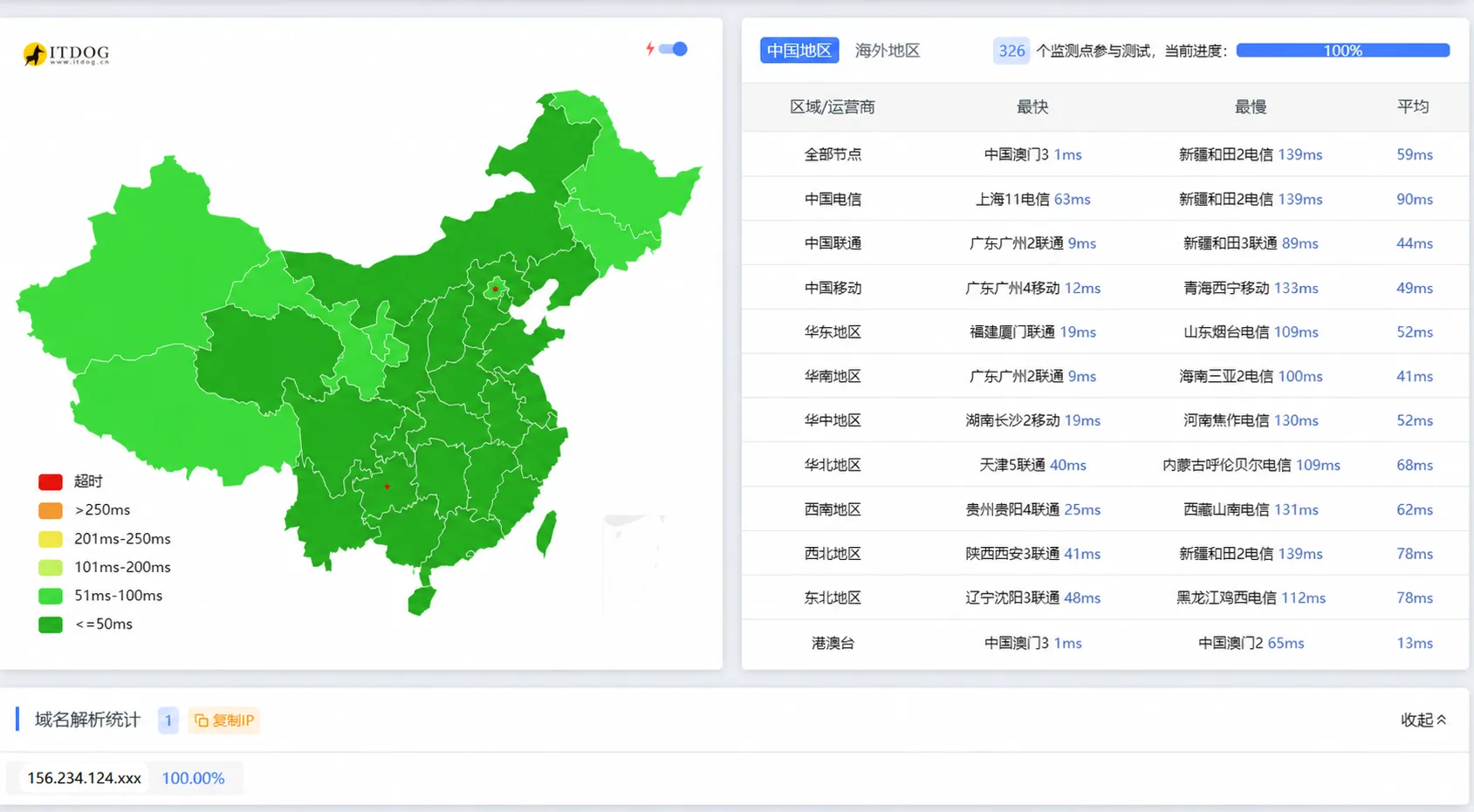
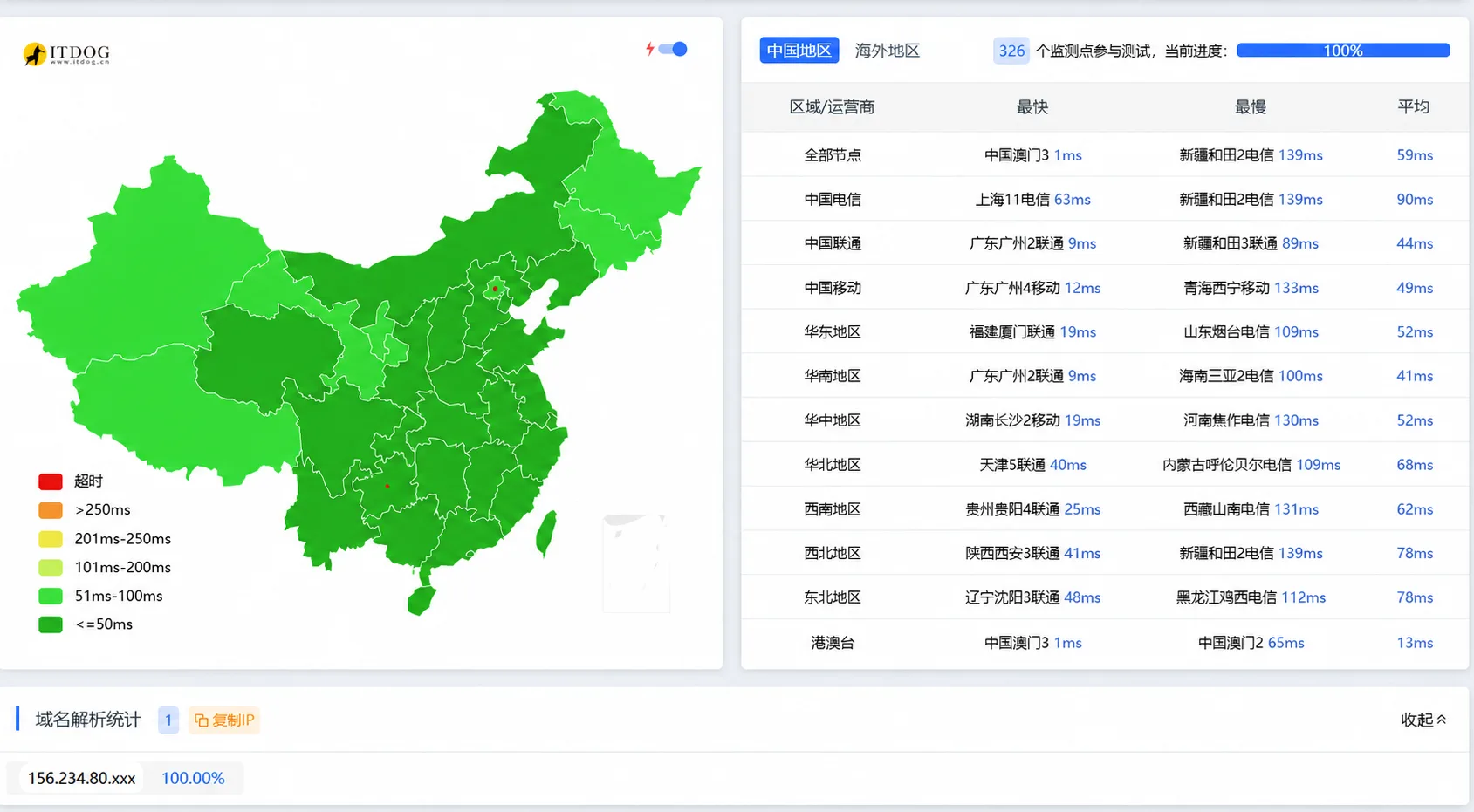
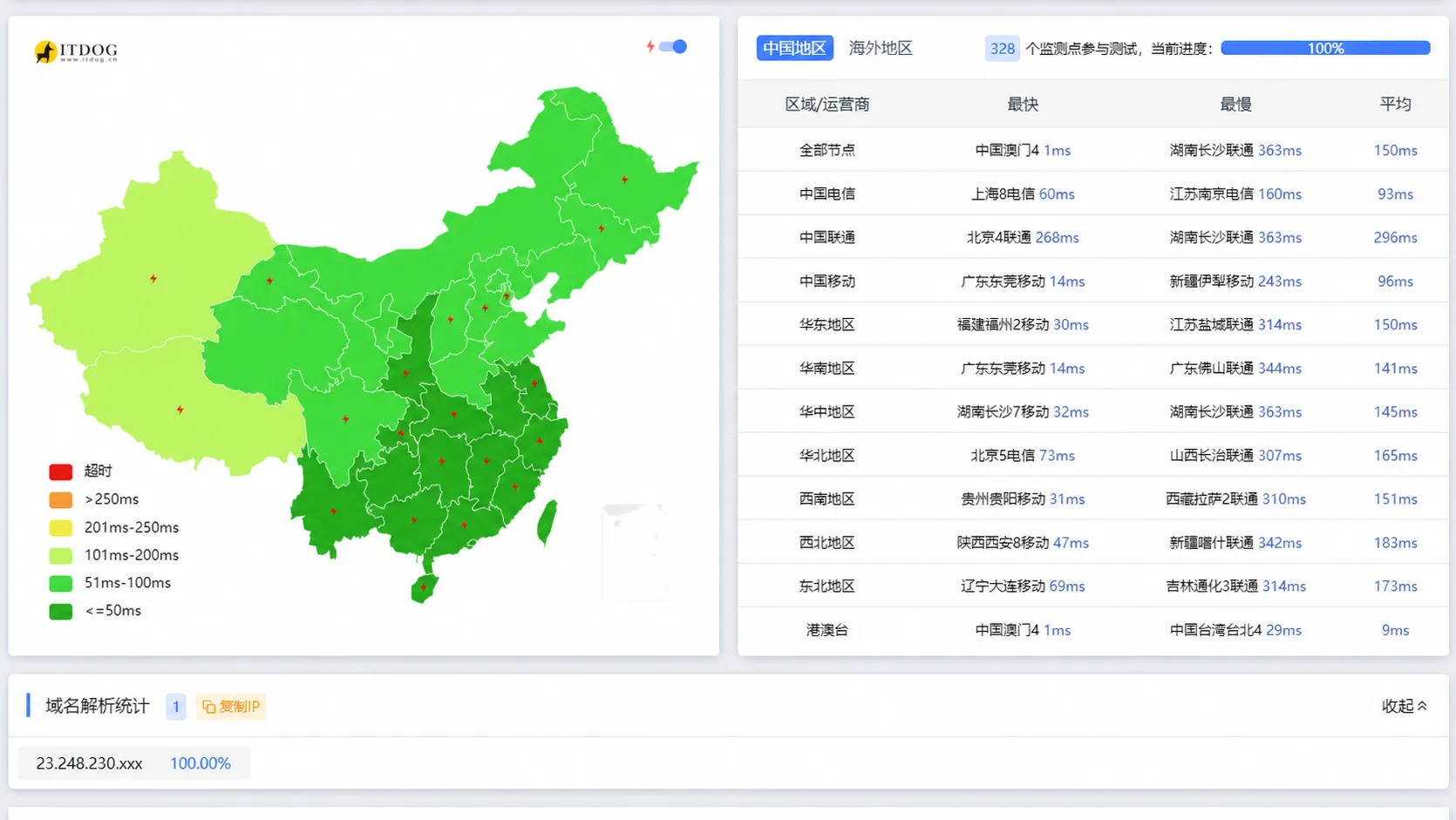
The image below was tested with the itdog China-region Ping tool, and the test progress was 100% for all. The average speed of both servers is fairly good; the cloud server's line is slightly slower.
Overseas platforms, streaming media, and social media access test
Some people buy Hong Kong servers to build their own VPN, or to operate overseas social media, overseas tools, and content platforms. This time the fusion monster also conveniently tested common overseas platforms; the actual results are listed below as a reference for those preparing for such uses.
The two dedicated servers share many results: Netflix, TikTok, X, YouTube, Reddit, Spotify, Google Search, etc. are accessible; ChatGPT shows „mobile app only“; Claude and Gemini show unavailable; Grok and Sora show Banned or VPN Blocked; Instagram Licensed Audio returned HTTP 429, which is a rate-limited state. TikTok„s detection result shows asALISG, not a fixed Hong Kong region.
The two machines also differ: #217„s DeepSeek shows Banned, while #216 shows YES, Region: HK. In the IP quality check, both are identified by multiple databases as hosting/data center, but results such as “whether VPN„ and “whether proxy„ are not entirely consistent; some databases for #217 also show DNS blacklist records, while #216 has fewer public blacklist records.
In this fusion monster result for the cloud server, Netflix, TikTok, X, YouTube, Reddit, Spotify, etc. are also accessible; ChatGPT shows mobile app only, Claude and Gemini are unavailable, and Grok and Sora are restricted. The cloud server's IP quality check shows hosting, with no obvious malicious votes in public databases, but such results will change with how the IP is used.
If you plan to use such servers for social media operations, what really matters is whether the target platform can log in and publish content normally, and whether the account will frequently require verification later. This article only tested public pages and basic access; it did not log in to personal accounts, nor did it perform bulk registration or automated posting. In actual use, it is recommended to start with a monthly payment to try it out, and go through the login, publishing, and account verification processes once.
About defense capability
The merchant„s page and customer service provided statements such as “unlimited defense„ and “200G„. Because Naiba does not have the conditions to test attack defense on a large scale, if you really need a defense-oriented server, ask the merchant clearly before purchasing about the defense scope, scrubbing method, TCP/UDP support, trigger conditions, blocking policy, and refund policy.
Tools used in this test
This test used the full version of Rongheguai v0.2.18, sysbench, fio, curl, Ping, MTR, ipip.net, and itdog. If you want to retest yourself, you can refer to this site'sVPS Test Script Collection。
Server 30% off coupon code YGFQYCPPUE9FU