
This article was first published in 2020. Today, a coaching user mentioned this issue again, so I refreshed this article. Back in 2020, that boss thought, „For SEO of foreign trade website articles, find keywords, add them to the article using Yoast, optimize the Yoast light to green, and persist for half a year but fail. Why is that?“
Today„s coaching user“s question is: „Does every page need to be optimized with an SEO plugin? How far should the suggestions from SEO be optimized?“
Both questions boil down to one thing: mistakenly thinking that the SEO plugin's "traffic light" is an exam scorer, and every article must be fully green to pass. In fact,Pursuing a perfect score is often the beginning of over-optimization.
In this article, Naiba will discuss:how to layout article keywords for SEO on a foreign trade website, andHow to correctly use the indicators of Yoast SEO/Rank Math. The core point of this article is clear:SEO plugins are auxiliary tools, not exam scorers; content quality and user experience always come before plugin scores.
1. The Essence of SEO Plugins: What Are They Really Evaluating?
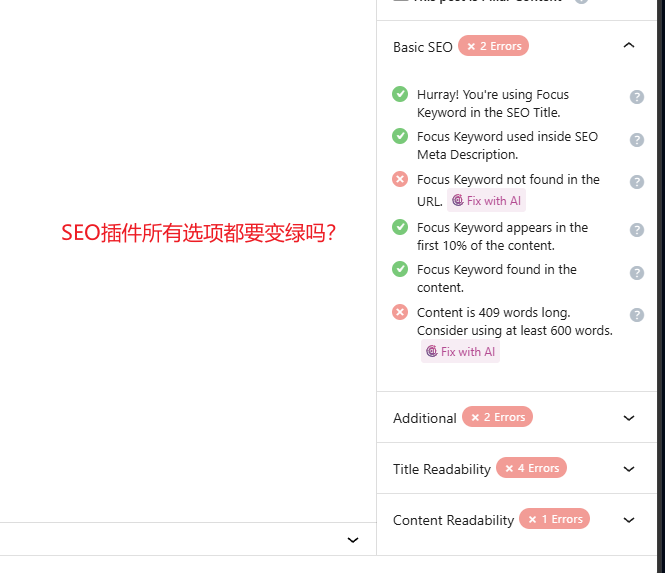
Tools like Yoast and Rank Math score based on a fixed set of rules, such as:
- Whether the keyword appears in the title, H1, and first paragraph
- Whether the total word count exceeds a certain threshold
- Whether the number of internal links is sufficient (usually 1-2 recommended)
- Whether images have Alt text
- Whether sentence length and paragraph length meet readability standards (Flesch reading ease)
- Whether the meta description contains the keyword and is of appropriate length
These rules make sense, but Google's ranking algorithm goes far beyond them. Google relies onSemantic understanding + User experience + Authority signalsto determine rankings. The plugin only sees the superficial "whether it exists," while Google looks at "whether it's good" and "whether it matches search intent."
A typical phenomenon is that many top-ranking pages may have an orange or even red SEO score from Yoast or Rank Math, but their content accurately answers user questions, loads quickly, and has high-quality backlinks.
So, don't be gaslighted by that "traffic light."
2. Three-Step Keyword Layout Method
When doing SEO, the most important thing is to rely on articles. Article quality is very important, but many foreign trade professionals are fine with business talks but struggle to write articles. They can't come up with many, or they repeat themselves for months, feeling stressed.
Persisting in writing original articles is quite difficult. For example, it took Naiba about an hour to revise this article. Although SEO can now use AI to write articles, to resonate with users, articles still need manual revision, polishing, and verification (you should know AI likes to make things up).
Naiba will demonstrate with actual examples:How to mine keywords and lay them out in article content for SEO optimization.
Step 1: Find Keywords
There are many third-party tools for finding keywords. You can refer toGoogle SEO TutorialThe tools section of the page. Here Naiba directly usesGoogle search box dropdown suggestionsas an example.
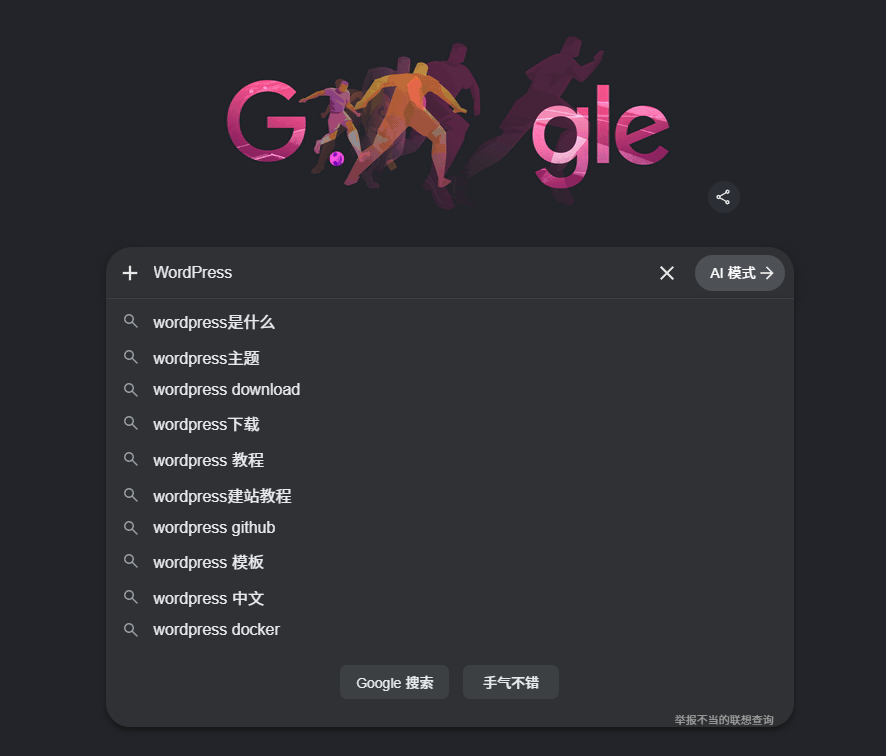
Take WordPress as an example. After entering WordPress, you can see many Google-recommended search terms in the dropdown, all of which have a certain search volume.
Introduction to Keyword Types:
The word WordPress is themain keyword, while the dropdown terms like "What is WordPress" and "WordPress themes" are calledderivative keywords(also known as common keywords).
And "how to use wordpress to build a website" is considered along-tail keyword(other words related to problems encountered on WordPress are also long-tail keywords).
Core keywords are fewer in number and highly competitive; common keywords are moderate in both quantity and difficulty; long-tail keywords are the most numerous, with the lowest optimization difficulty, but they also have the fewest searchers.
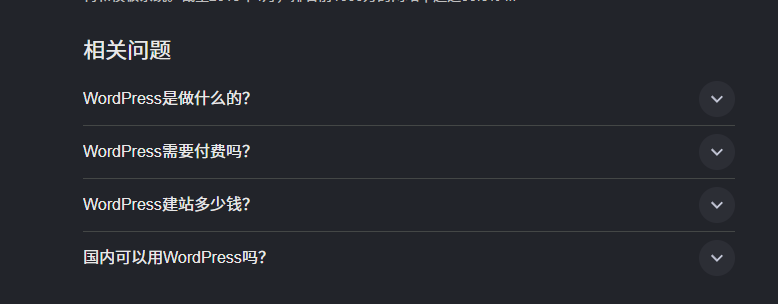
Randomly search for a word, and the related questions that appear can also be used as SEO topics.
Key Considerations for Keyword Selection:
- When writing articles, you usually don't need to choose the main keyword, because the main keyword is highly competitive and not precise enough, making it difficult to rank for the main keyword with an article. Generally, when writing articles, we write about somelong-tail keywordor medium-competition keywords.
- The main keyword is usually placed on the homepage of the website, but you also need to choose the right main keyword.For example, if you are an SEO company, isn„t choosing “WordPress SEO optimization„ as your website“s main keyword more appropriate than „WordPress“ or „SEO optimization“?
- Don't think that if a keyword doesn't bring conversions, you shouldn't write about it.This is a problem many friends who have done Google Ads promotion encounter, because they think these words don't bring conversions, so writing about them is a waste of time and energy. Actually, that's not the case. Take the word "WordPress Login" as an example. It indeed cannot directly bring conversions, but it is an article about WordPress and a WordPress tutorial. If your website mainly introduces "Building a website with WordPress„, then doesn“t this article enhance your website„s focus on WordPress? At the same time, this article is about “How to do keyword layout for foreign trade websites when writing articles„, doesn“t it indirectly deepen the content depth of the website in „Foreign Trade Website Building„ and “Google SEO„? If this article gets ranked, it will also increase the website“s authority (i.e., website weight. Also, did you notice that I added two internal links to my article in this paragraph?).
Step 2: Research articles related to the selected keywords
This research is relatively simple: take the keyword, search it in Google, and read the top-ranking articles.
Analyze and summarize the top-ranking articles:
- what content they include;
- whether there is outdated information;
- whether there is incorrect information;
- whether you have more comprehensive information than they do.
Then summarize and write an article on thesame topic, but with richer content.
Step 3: Write articles around the keywords
Whether the article is well-written and meets user needs is more important than your SEO plugin showing green lights.When writing an article, just keep in mind whether it will be helpful to users and whether it is a shallow piece.
SEO plugin promptsshould only be used as a reference, not like exam-oriented education; everything should be based on article content and user experience.
For example, Naiba„s article titled “Foreign Trade Website Article Keyword Layout Method: It„s Not Enough to Make Yoast SEO Green“ mainly discusses how to select keywords in the first half, and only touches on writing articles around keywords in the third step, but the content is not deep enough, so I need to supplement some article keyword layout methods.
The most common keyword layout methods:
- The title must include the keyword;
- The first paragraph of the article should preferably include the keyword;
- Show the keyword in appropriate places in the article body (be careful not to stuff keywords randomly);
- Appropriately include some long-tail keywords related to the keyword in the article;
- Mention the keyword once at the end of the article;
- Add internal links with the keyword to this article from other pages of the website when appropriate.
3. Does every page need to be optimized to perfection?
This is a concern for many, especially beginners.Naiba can say with certainty, no.SEO plugin suggestions should only be used as references; you should not blindly adopt all recommendations without your own judgment.
We can categorize website pages into three types:
Traffic pages: worth detailed optimizationIncluding the homepage, core product pages, and high-search-volume blog posts. These pages directly address user search intent and are the main drivers of traffic and conversions. It's worth spending time optimizing titles, meta descriptions, H1 structure, internal links, Schema markup, etc.
Supporting pages: basic optimization is sufficient, no need to pursue perfectionFor example, About Us, Privacy Policy, Contact Us, category archive pages, etc. Users typically visit these pages with a clear purpose, not through SEO traffic. Ensure clear titles and descriptions, basic H1 tags, and readability. No need to obsess over keyword density or orange rating lights.
Low-value pages: consider noindex or minimal managementTest pages, draft pages, tag pages, duplicate content pages. If indexed, these pages may dilute the crawl budget or compete with canonical content. Decisively set them to noindex, mark them as 'invisible' in the plugin, or even delete them outright.
Take the simplest example: for pages like About Us and Contact Us on a corporate website, is it necessary to specifically optimize the title and description? Even if you optimize them to perfection, they are still About Us and Contact Us pages. Do you expect people to search for 'About Us' or 'Contact Us' to get traffic?
But for your service pages, for example, if you do custom hat making and have a customization service, then this page must be optimized. Because the title of this page on your site might just be „Services“, and people searching Google for „custom hats“ won„t find you. With the help of an SEO plugin, you can change the page title to “Custom Hat Service„.
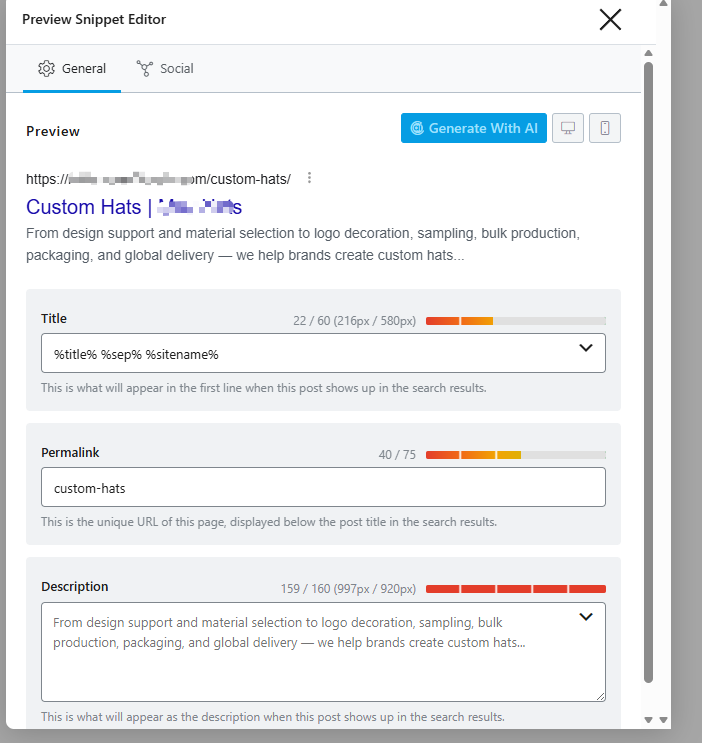
Without optimization, this page would appear in Google„s structure as “Custom Hats – Site Name„. But by customizing the Title and Description in the SEO plugin, you can fill in:
- Custom Hats | Embroidered Logo Caps, Bulk & Personalized Hats | Site Name
- Custom Hats – Custom Baseball, Trucker & Snapback Caps | Site Name
- Custom Hats: Personalized Embroidered Caps for Business & Events | Site Name
This way, the content appearing in Google search results is richer, and there are more search terms.
Description can be filled with:
- Shop premium custom hats with custom logo embroidery. Bulk orders & no minimums available for businesses, teams, weddings & gifts. Free design preview, fast shipping. Get your personalized caps today.
- Design custom hats online: baseball, trucker, snapback & beanies. Custom embroidery & printing for corporate, sports teams & events. Fast turnaround, free design support.
- Order custom embroidered hats for brands, groups & gifts. Choose trucker, baseball & fitted caps. Low minimums, free mockups & reliable bulk delivery.

Note that Google does not always display the title and description you set. In different search scenarios, Google may show content it deems more relevant to the search results.
4. To what extent should you optimize? Establish a 'three-color priority' standard
Instead of staring at the plugin's traffic lights, it's better to establish a more reliable judgment standard. I call itthe „Three-Color Priority“:
| Priority | Optimization item | Recommendation | Time Investment |
|---|---|---|---|
| 🟢 Green Light Zone (Must Do) | Title tag, meta description, H1 structure, mobile responsiveness, loading speed, natural occurrence of core keywords | Must Do | 10 minutes per page |
| 🟡 Yellow Light Zone (Recommended) | Internal link layout, image alt text, Schema structured markup, URL readability, readability score | Recommended | 5 minutes per page |
| 🔴 Red Light Zone (Proceed with Caution) | Deliberately stuffing keyword density, forcing keywords into every subheading, sacrificing natural expression for plugin scores | Proceed with Caution / Do Not Do | 0 minutes |
Key Principle: When a plugin's suggestion (e.g., requiring repeated keywords in a paragraph) conflicts with the user's reading experience, prioritize user experience. An article that reads smoothly and has clear logic is more likely to gain Google's favor than one that scores all green in a plugin but reads awkwardly.
5. Five Ranking Factors More Important Than Plugin Scores
The following five factors have a much greater impact on rankings than the traffic light score in a plugin:
1. Whether the content truly answers search intentIf a user searches "how to optimize WordPress website speed," you provide a set of actionable steps, not an introduction to server history.
2. Page Experience Metrics (Core Web Vitals)Loading speed, interaction latency, visual stability—these are Google's hard metrics (however, Naiba's view is that the actual user opening speed still matters; sometimes users open the site quickly but the score is not high, and sometimes the score is high but users open the site slowly).
3. Backlinks and Internal Authority StructureHigh-quality backlinks pass authority, and a reasonable internal link structure helps search engines understand content hierarchy.
4. Content Freshness and Update FrequencyRegularly updating old articles and consistently publishing new content signals to Google that the site is active.
5. SERP Click-Through Rate (Attractiveness of Title and Description)Even if ranked first, if the title and description are not attractive, users won't click. Use SERP knowledge to optimize click-through rate.
6. Practical Checklist: SEO Optimization Process for an Article
Don't worry, follow this checklist step by step, and once done, you can let it go:
🟢 Mandatory:
- Determine the core keyword (1), naturally include it in the title, H1, first paragraph, and URL
- Write a meta description (including the keyword and attractive to clicks)
- Set up H1-H3 structure
- Ensure mobile display is normal
🟡 Recommended:
- Add at least 1 internal link to related articles on the site
- Add Alt text to the main image (including the keyword)
- Check paragraph length, average no more than 5 lines
🔴 Optional:
- Keyword density not up to standard? Don't force it, just keep it natural
- Plugin prompts 'Not enough external links'? Not mandatory
- If readability score is yellow, as long as sentences are smooth, no need to change
After writing, read through it yourself, focusing on whether the page content is smooth, and whether the title, meta description, and H tags are reasonable (to be honest, if you actually read through each article after writing, your SEO results shouldn't be too bad; if there's no effect, it's likely you're writing carelessly).
Core principle: For content meant for users, first make users comfortable, and search engines will follow.
VII. Frequently Asked Questions (FAQ)
Q: What score is considered passing for SEO plugins?
A: Don't pursue 100 points. For traffic pages, it's recommended that core indicators (title, meta description, H1) must meet standards, and readability and keyword density can reach 60-80 points. For supporting pages, maintain basic optimization; the score is not the core consideration. The SEO plugin used by Naibabiji does not have a scoring system.
Q: Why is Yoast green but still no ranking?
A: The plugin's green light only indicates basic SEO elements are complete, not that content quality is high, backlinks are strong, or it matches search intent. Ranking is a comprehensive result of content quality, technical SEO, user experience, and backlink authority. The classmate who ranked first in high school may not be more accomplished than you now.
Q: What is the appropriate keyword density?
A: Don't be superstitious about specific percentages. Naturally appearing 3-5 times for the core keyword is enough. Overstuffing will be considered keyword stuffing by Google and is harmful.
Q: Do old articles need to be rechecked and optimized with plugins?
A: Articles that have traffic but poor rankings can be updated; those with stable traffic and rankings should be monitored; those with no traffic can be ignored or rewritten directly.
Q: Does every page need SEO optimization?
A: No. Layer by ROI: traffic pages get detailed optimization, supporting pages get basic optimization, and low-value pages are directly noindexed.
A real example
Having said that, Naiba will give you an example. Take theVPS recommendation pageas an example.
This article ranks quite well on Google, basically in the top three, but mostly in third place.
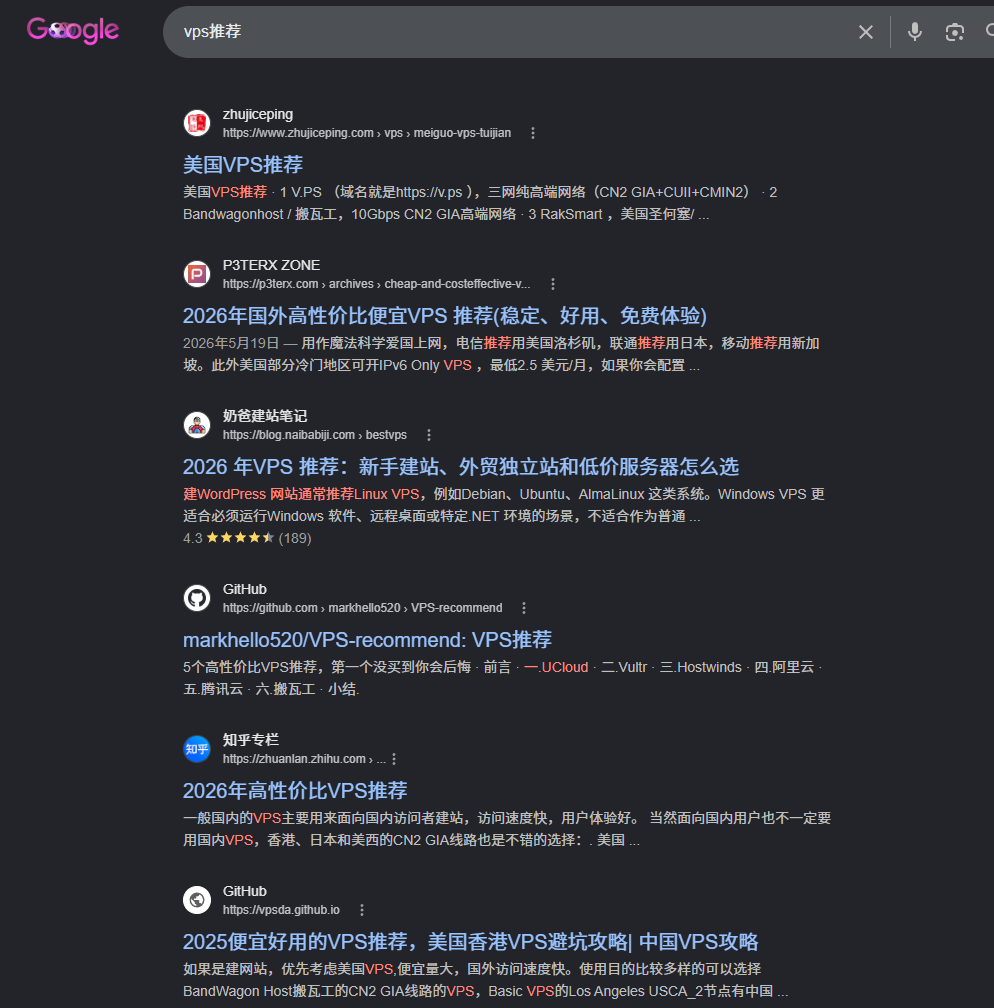
I haven't analyzed any external or internal links, justTaking the SEO plugin mentioned in this article as an example:
For the first website, did you see any separate optimization for its title? No, but it ranks first.
For the 4th and 6th, did they optimize? No, they still use GitHub.
What does this show?
True SEO ranking has no direct relationship with whether your SEO plugin light is green or not.
Is it related to page design?
Maybe, but not much. Naiba thinks my page looks more comfortable than the top two, but it doesn't rank.
So, excluding external links, the remaining factors, as Naiba guessed, are vertical authority and authority.
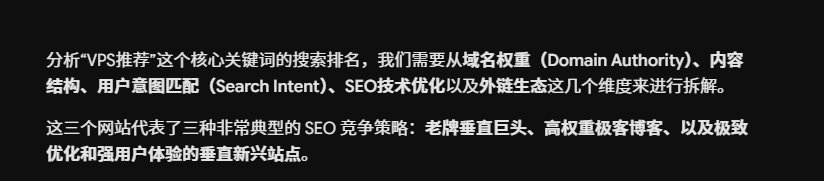
Naiba asked Gemini, and the result was similar to my guess.
To analyze the search ranking of the core keyword „VPS Recommendation“, we need todomain authority, content structure, search intent matching, SEO technical optimizationandexternal link ecosystemthese dimensions to break it down.
These three websites represent three very typical SEO competition strategies:established vertical giant, high-authority geek blog, and vertically emerging site with extreme optimization and strong user experience。
The first-ranked host review has a long history in the hosting industry and belongs to a vertical field. (Naibabiji is more about WordPress website building knowledge.)
The second-ranked P3TERX ZONE is a well-known blog in the geek circle. Because it provides a large amount of high-quality technical content, it has gained a massive number of high-authority, high-quality natural external links from the tech community, GitHub Profile, and other tech blogs.
Ah, seeing the evaluation of Naibabiji, Naiba feels embarrassed, (●’◡’●), Gemini actually gave me such a high rating.
“奶爸笔记” 则代表了新一代独立博客的进化方向——通过极致干净的页面性能、高度精炼且结构化的数据呈现、以及无可挑剔的现代 UI/UX 体验,在老牌巨头的夹击下生生撕开一条口子,稳居第一梯队。
Summary of Article Keyword Layout
总的来说,想要正确的布局好关键词,并且获得Google搜索排名,只需要注意以下这几点就可以了:
- 围绕你研究出来的这个关键词写文章,文章内容做到比其他排名前面的网页更新、更详细、更权威;
- 写文章的时候心里想着这个关键词以及关键词的一些同义词、近义词,合适的时候用上;
- Appropriate positionAdd internal and external links to the website;
- Consider the article from the user's perspective: put the content that most users care about first, and secondary content later;
- Do not sacrifice content quality for plugin scores, the green zone must be done, the yellow zone is recommended, and the red zone should be done with caution.
Of course, you still need to learn basic SEO writing techniques, such as including the keyword in the first paragraph of the article, using the keyword or related terms in subheadings, etc. SEO plugins like Yoast and Rank Math will also give you prompts.
Compared to keyword layout, through the actual case of the term „VPS recommendation“ above, I believe everyone understands that the more core content isFocus on vertical content, accumulate experience and technical output, and turn your website into an authoritative site in the field. Naturally, rankings will not be bad.
Finally, if the article has inspired you, I hope you can give Naiba a little encouragement to let me know that my article is useful to you.